680µF 16V Radial Cap: Reliability Guide & Specs
When procuring the CAP ALUM 680UF 20% 16V RADIAL (Brand: NTE Electronics, Inc, SKU: NEV680M16DE), a quality and reliability engineer must consider standards that govern aluminum electrolytic capacitors. This component should comply with IEC 60384-4 (fixed capacitors for electronic equipment) and EIA-IS-749 for aluminum electrolytic capacitors used in power supply applications. Qualification typically involves meeting MIL-PRF-39018 performance criteria for industrial-grade parts, though NTE components are often commercial or industrial grade. Key parameters include rated voltage (16V), capacitance tolerance (±20%), and operating temperature range (usually -40°C to +105°C for this type). The component must also pass load life testing at rated ripple current and maximum temperature for 1,000 to 5,000 hours, with capacitance change within ±20% and leakage current below specified limits.
Accelerated life testing (ALT) for this capacitor is critical to predict long-term reliability. Testing is often conducted at elevated temperature (e.g., 85°C or 105°C) with applied voltage and ripple current. The Arrhenius model is used to extrapolate acceleration factors; a typical 10°C increase in temperature halves the expected life. Results from ALT indicate the capacitor's endurance under stress, with failure criteria such as capacitance drift >20%, increase in tan δ (dissipation factor) >200%, or short/open circuits. For the NEV680M16DE, a successful ALT run at 105°C for 2,000 hours suggests a useful life of over 10 years at 40°C ambient, assuming derating. The wear-out mechanism is electrolyte evaporation, so ALT helps estimate end-of-life due to dry-out.
Failure rate calculations for aluminum electrolytic capacitors focus on FIT (Failures In Time) rates and MTBF (Mean Time Between Failures). FIT rates are typically in the range of 10 to 100 FIT for these components under normal operating conditions (40°C, 0.5 rated voltage). Using the MIL-HDBK-217F reliability prediction model, the FIT rate for a 680µF, 16V radial electrolytic is approximately 20 FIT per million hours, corresponding to an MTBF of 50,000 hours. However, this value is highly dependent on temperature and ripple current. Derating to 80% of rated voltage and keeping ambient temperature below 75°C can reduce FIT to 5-10 FIT, yielding an MTBF of 100,000 to 200,000 hours. It is critical to note that aluminum electrolytics have a wear-out failure mode, so MTBF assumes a constant failure rate only during the useful life period, typically 5-15 years.
Environmental stress screening (ESS) and burn-in procedures help identify infant mortality failures. For the NEV680M16DE, recommended burn-in conditions include applying rated voltage (16V) at 85°C for 48 to 100 hours, with periodic measurement of capacitance and leakage current. This stresses the dielectric oxide layer and seals, revealing weak units. Temperature cycling from -40°C to +85°C for 10 cycles is advisable to expose mechanical defects in the radial leads or internal connections. Vibration testing per MIL-STD-202 method 204 (5-500 Hz, 2.0g) can detect poor solder joints or loose internal elements. ESS should be performed on a sample basis (e.g., 10% of lot) with pass/fail criteria based on capacitance change <5% and leakage current not exceeding 0.01CV or 3µA, whichever is greater.
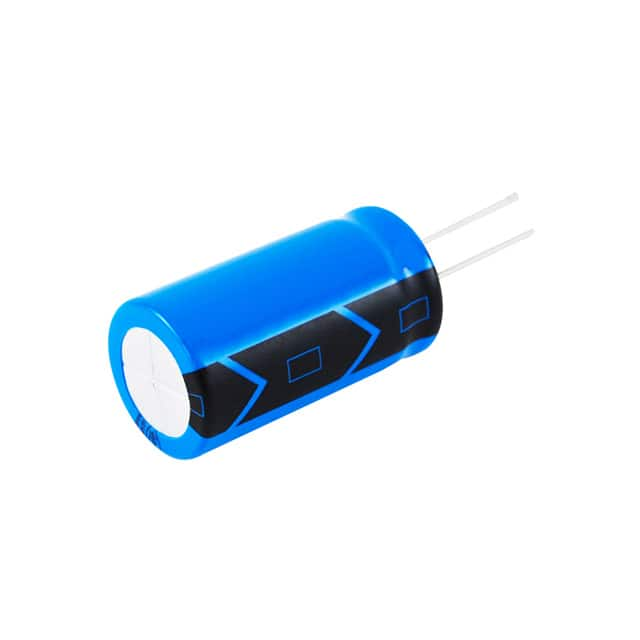
Counterfeit detection is essential for this radial aluminum electrolytic capacitor. Visual inspection under 10x-40x magnification can reveal anomalies: blurred or misaligned markings, uneven sleeve material, or non-standard lead plating (should be tin-plated copper or steel). Authentic NTE parts have consistent brand logo and part number font. Weight check is useful—genuine units have a specific mass due to the aluminum can and electrolyte. Counterfeits often use different casing materials or fillers. X-ray fluorescence (XRF) analysis can verify lead-free compliance and detect mismatched internal construction, such as a smaller core than expected. Electrical testing for capacitance, tan δ, and leakage current at 20°C and 85°C can expose poor dielectric quality, a common counterfeit indicator. Always require a Certificate of Conformance (CoC) from authorized distributors like NTE Electronics.
Incoming inspection best practices for the NEV680M16DE should follow ANSI/ESD S20.20 electrostatic discharge precautions, though these capacitors are relatively ESD-insensitive. Key inspection steps include: 1) Visual and dimensional check—measure diameter (typically 10-12.5mm), height (20-25mm), and lead spacing (5mm radial) per datasheet. 2) Capacitance measurement at 120 Hz using an LCR meter; tolerance should be ±20% (544-816µF). 3) Dissipation factor (tan δ) must be ≤0.12 at 20°C. 4) Leakage current test at 16V for 2 minutes; maximum is 0.01CV or 3µA (108.8µA typical). 5) Impedance at 100 kHz should be low (e.g., <0.5Ω) for proper ripple current handling. Sample size per lot should be at least 20 pieces or based on AQL 1.0% per ANSI/ASQ Z1.4.
Storage and handling are critical to maintain reliability. Aluminum electrolytic capacitors have a limited shelf life due to electrolyte degradation. Store the NEV680M16DE in a cool, dry environment at 5-35°C and <45% relative humidity. Avoid exposure to volatile organic compounds (e.g., solvents, solder flux fumes) that can corrode leads. If stored for more than 18 months, a reforming process is recommended before use: apply rated voltage through a 1kΩ resistor for 1 hour at room temperature to restore the oxide layer. Keep components in original sealed packaging to prevent moisture ingress. For batch handling, use anti-static trays and avoid mechanical shock that could damage the rubber seal or lead welds.
End-of-life management and obsolescence planning require proactive strategy. NTE Electronics may continue production of the NEV680M16DE, but aluminum electrolytics are subject to raw material shortages (e.g., aluminum, electrolyte chemicals). Monitor lead times and set last-time buy (LTB) triggers at least 12 months before expected obsolescence. For long-life equipment, consider derating the voltage to 12V and operating temperature below 70°C to extend useful life to 20+ years. Establish a qualified replacement list with equivalent parts from Panasonic (e.g., EEU-FR series) or Nichicon (e.g., UHE series) that have similar form, fit, and function. Implement a lifecycle assessment for devices using this capacitor, scheduling replacement during maintenance cycles. For critical applications, use a reliability buffer by parallelizing capacitors or selecting a higher voltage rating (e.g., 25V) to mitigate wear-out failures. Finally, maintain traceability through date codes and lot numbers to manage recall or degradation trends.