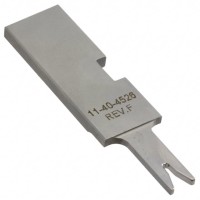
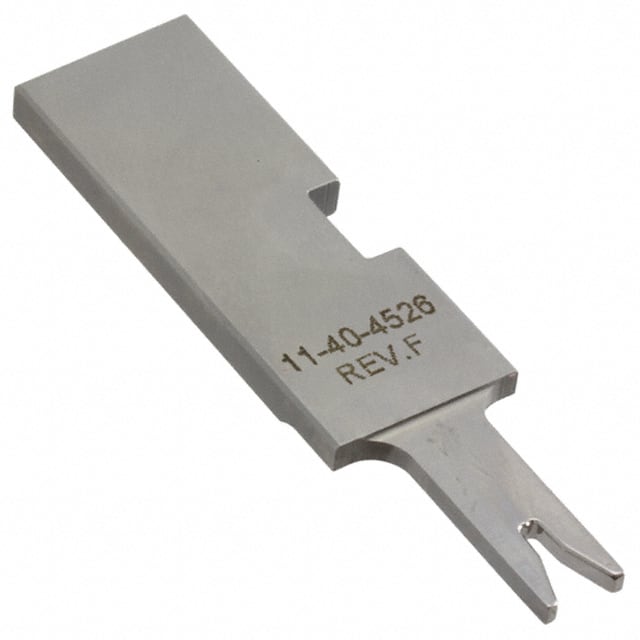
8352-6 Conductor Punch: Key Industry Insights & Applications
In the intricate world of electronic interconnect solutions, the wire termination punch, such as the Molex 8352-6 CONDUCTOR PUNCH (SKU: 0011404526), represents a critical, yet often overlooked, element of reliable system design. This specific tool, part of Molex's industrial tooling ecosystem, is engineered for the precise, repeatable termination of conductors in heavy-duty connectors. Its role is foundational: ensuring a gas-tight, low-resistance connection that withstands vibration and temperature extremes. Understanding the trajectory of this component segment is essential for procurement professionals aiming to secure both cost and quality.
The technology behind the 8352-6 CONDUCTOR PUNCH is precision mechanical engineering. It is designed to work in conjunction with pneumatic or manual application tools to crimp or punch wire insulation displacement connectors (IDCs) or similar terminal blocks. Recent innovations in this space are not about radical redesigns but about material science and process control. Molex and its competitors are now utilizing advanced, high-wear tool steels with coatings like Titanium Nitride (TiN) or Diamond-Like Carbon (DLC) to extend punch life thousands of cycles beyond previous generations. Furthermore, the integration of force-sensing technology into tooling is emerging. While the 8352-6 itself is a mechanical punch, the systems it fits into are increasingly 'smart,' with real-time monitoring of crimp height and pull-out force. This data-driven approach is moving the segment from a 'good enough' manual process to a statistically controlled, zero-defect production method.
Market trends driving demand for the 8352-6 and similar conductor punches are firmly rooted in the electrification of everything. The primary demand driver is the global push for renewable energy infrastructure. Solar inverter systems, wind turbine control cabinets, and battery energy storage systems (BESS) require thousands of highly reliable wire-to-board and wire-to-wire connections. Each of these connections must be terminated with a punch tool to ensure consistent signal integrity and current-carrying capacity. The automotive sector, particularly electric vehicles (EVs), is another massive demand driver. High-voltage wiring harnesses in EVs demand termination processes that can handle larger gauge conductors in harsh, vibration-prone environments. The 8352-6, designed for industrial-grade performance, is directly applicable to these high-reliability applications.
Supply chain dynamics for specialized tooling like the Molex 8352-6 are currently navigating a period of transition. Global sourcing has become more complex. While Molex maintains strong manufacturing in the United States and Mexico, the supply of raw high-grade tool steel and precision-ground components is subject to global commodity price fluctuations. Lead times for such tooling have stabilized from the extreme volatility of 2021-2022, but they remain extended—typically 8 to 14 weeks for standard punches and up to 20 weeks for custom or high-tolerance variants. Lead times are driven by the need for specialized precision grinding and finishing, which cannot be easily expedited. The pricing outlook is moderately bullish. We anticipate 3-5% annual price increases driven by rising costs for high-performance tool steel and skilled labor. However, the real cost is not the punch itself but the cost of downtime if a punch fails. Procurement must prioritize quality over the lowest unit price.
Emerging applications are creating new demand vectors for the 8352-6 CONDUCTOR PUNCH. Beyond renewable energy and EVs, the rise of edge computing and data centers is a key growth area. High-density server racks require robust power distribution, and the connectors terminated by these punches are critical for backplane and power supply units. Another emerging application is in advanced robotics and industrial automation (Industry 4.0). Collaborative robots (cobots) and automated guided vehicles (AGVs) rely on connectors that can handle rapid flexing and high cycle counts, demanding termination punches that produce consistently perfect connections. The medical device sector, particularly diagnostic imaging equipment, also requires the high-reliability terminations that only a dedicated punch can provide.
Looking at the technology roadmap for this component category, the future is about integration and automation. The next generation of conductor punches will likely incorporate embedded sensors that communicate directly with a plant's MES (Manufacturing Execution System). This 'smart punch' will log every termination, recording parameters like cycle count, force curve, and even operator ID. This data enables predictive maintenance—replacing the punch just before its wear tolerance is exceeded, not after a failure. Additionally, we expect to see modular punch systems that can be quickly field-reconfigured for different wire gauges and connector types, reducing tool changeover time. For the Molex 8352-6 specifically, future iterations may feature interchangeable anvils or inserts to accommodate evolving wire insulation materials, such as thinner, more flexible polyolefin blends used in automotive battery packs.
Industry regulations are a non-negotiable factor in the procurement and use of the 8352-6. While the punch itself is a metal tool, the applications it enables must comply with stringent environmental and safety standards. RoHS (Restriction of Hazardous Substances) and REACH (Registration, Evaluation, Authorisation and Restriction of Chemicals) compliance is mandatory for the materials used in the connectors and wires that the punch terminates. For automotive applications, tools used in the production of safety-critical systems must often meet IATF 16949 quality system requirements. This means the punch's manufacturing process must be traceable, and its performance must be validated to ensure it does not introduce defects. Procurement teams must verify that their Molex tooling supplier provides documentation of the punch's material composition and heat treatment, as these directly impact its ability to produce compliant terminations.
Strategic recommendations for procurement teams managing the Molex 8352-6 CONDUCTOR PUNCH are clear. First, treat this tool as a critical consumable, not a commodity. Establish a safety stock of at least two units to mitigate lead time risk. Second, invest in a tool lifecycle management program. Track the number of cycles each punch has performed and set a replacement threshold based on manufacturer recommendations (typically 50,000 to 100,000 cycles for premium punches). Third, build a direct relationship with Molex's authorized distributors or the factory for technical support, especially regarding application-specific validation. Fourth, demand full material and regulatory compliance documentation upfront. Finally, consider the total cost of ownership. A higher-priced punch from Molex, with its superior wear life and repeatability, will deliver a lower cost per termination than a cheaper alternative that causes rework or field failures. By adopting these strategies, procurement can transform a simple tool purchase into a driver of overall production reliability and quality.