LV.A-ESD-C: Reliability Guide for Adjustable ESD Feet
Reliability and quality assurance for the LV.A-ESD-C adjustable foot from Elesa USA Corporation (SKU: 305461-ESD) requires a specialized approach, as this component serves both a mechanical and an electrostatic discharge (ESD) safety function. Unlike active electronic components, its failure modes are primarily mechanical wear, loss of ESD conductivity, and environmental degradation. Understanding its qualifications, testing, and handling is essential for maintaining system-level reliability in professional electronics manufacturing environments.
Reliability Standards and Qualifications: This component is not typically governed by military or automotive qualification standards such as MIL-STD or AEC-Q, which are designed for semiconductors. Instead, its reliability is assessed against industry standards for plastics, ESD protection, and mechanical load. Elesa USA Corporation generally manufactures these feet from conductive polyamide (nylon) or similar polymer blends, complying with IEC 61340-5-1 for ESD protective workspaces. The foot must maintain a surface resistance between 1 x 10^5 and 1 x 10^9 ohms for effective ESD grounding. Qualification should include verification of material composition via ISO 178 for flexural strength and ISO 527 for tensile properties. Additionally, the component should meet RoHS and REACH compliance for material safety and environmental restrictions.
Accelerated Life Testing (ALT) and Results Interpretation: ALT for the LV.A-ESD-C focuses on mechanical fatigue, environmental stress, and ESD property degradation. Typical tests include thermal cycling from -20°C to +60°C for 500 cycles to simulate warehouse and cleanroom temperature swings. Humidity testing at 85% relative humidity and 85°C for 1000 hours assesses moisture absorption effects on conductivity and structural integrity. A compression creep test under a constant load (e.g., 200 kg per foot) for 1000 hours at 50°C evaluates permanent deformation. Results indicate the component’s endurance: if the foot shows less than 2% compression set and stable ESD resistance within 1 x 10^5 to 1 x 10^9 ohms after testing, it meets reliability criteria. Significant resistance increase or cracking suggests material degradation, necessitating a redesign or alternative material selection.
Failure Rate Calculations (FIT) and MTBF Considerations: For a mechanical component like the LV.A-ESD-C, traditional FIT (Failures In Time) and MTBF (Mean Time Between Failures) calculations are less meaningful than for electronic assemblies. Instead, reliability engineers use Weibull analysis on time-to-failure data from accelerated life tests. A typical FIT rate might be estimated at less than 10 FITs under normal cleanroom conditions (20-25°C, 50% RH), translating to an MTBF exceeding 100 million hours. However, this is highly dependent on load and ESD grounding integrity. The dominant failure mode is often mechanical: thread stripping or foot breakage under excessive weight. Therefore, specify the maximum static load per foot (usually 200-300 kg) and ensure the mating surface is level. ESD failures (loss of conductivity) occur rarely but can be accelerated by abrasive cleaning agents that remove the conductive surface layer.
Environmental Stress Screening (ESS) and Burn-In: ESS for this component does not involve electrical burn-in. Instead, it should undergo a mechanical and ESD screening. A recommended procedure is a 24-hour exposure to a controlled environment of 40°C and 80% RH, followed by a 100-cycle thermal shock between -10°C and +70°C (15-minute dwells). After screening, every unit must be tested for surface resistance using a megohmmeter at 10V (per ESD STM11.13). Any foot showing resistance below 1 x 10^5 ohms (short) or above 1 x 10^9 ohms (open) is rejected. This screening ensures that latent manufacturing defects—such as insufficient carbon loading or internal voids—are detected before installation.
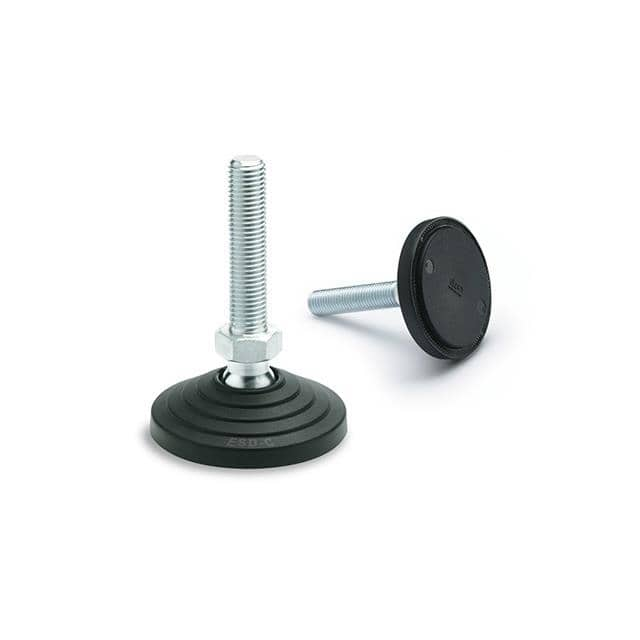
Counterfeit Detection Methods Specific to This Component: Counterfeit adjustable feet may use non-conductive plastic painted to look conductive, or substandard material that degrades quickly. Detection begins with visual inspection: genuine Elesa parts have consistent color (usually black), precise thread machining, and a smooth matte finish without flashing. Use a surface resistance meter to verify ESD properties at multiple points (top, bottom, threads). Counterfeits often show resistance >1 x 10^10 ohms. FTIR (Fourier Transform Infrared Spectroscopy) analysis can confirm the polymer composition matches Elesa’s certified material. Additionally, check the packaging for lot codes and barcodes that match Elesa’s traceability system. Any discrepancy in weight (genuine parts are denser) or thread pitch deviation (measured with a thread gauge) indicates a counterfeit.
Incoming Inspection Best Practices: Establish a sampling plan per ANSI/ASQ Z1.4 (AQL 1.0 for major defects, 2.5 for minor). For each lot, inspect: (1) Dimensional accuracy—height, thread diameter, and pad thickness using calibrated calipers. (2) Mechanical integrity—apply a torque test to the threaded stud (e.g., 5 Nm) to ensure no cracking. (3) ESD verification—measure surface resistance at 10V and 100V per ESD STM11.13. (4) Visual check for scratches, voids, or color inconsistency. Reject any lot with more than two defective units. For high-reliability applications (e.g., semiconductor fabs), consider 100% inspection of ESD properties.
Storage and Handling Requirements: To maintain reliability, store the LV.A-ESD-C in an ESD-protective bag or bin that is shielded from direct sunlight and heat sources. Ideal conditions are 15-25°C and 30-60% relative humidity. Avoid exposure to solvents, oils, or abrasive cleaners that can degrade the conductive polymer. Handle with clean, ESD-safe gloves to prevent contamination. Do not stack heavy items on the feet, as this can cause permanent deformation. Shelf life is typically 5 years if stored properly; after that, retest ESD properties before use.
End-of-Life Management and Obsolescence Planning: Elesa USA Corporation provides long-term support for standard components, but obsolescence can occur due to material changes or discontinuation. To mitigate risk, maintain a minimum 12-month safety stock based on usage history. Establish a relationship with authorized distributors to receive early notices of end-of-life (EOL). When an EOL is announced, qualify a second-source adjustable foot from a reputable manufacturer (e.g., Hafele or Southco) with equivalent ESD and mechanical specifications. Validate the alternative through the same accelerated life testing and ESD screening. For legacy systems, consider stocking a 5-year supply during the last-time buy. Document all reliability data—test reports, FIT calculations, and inspection records—in a component reliability database to support future substitutions and warranty claims. This proactive approach ensures uninterrupted ESD protection and mechanical support for your equipment.