5 Common OM3 12-Fiber Harness Cable Issues & Fixes
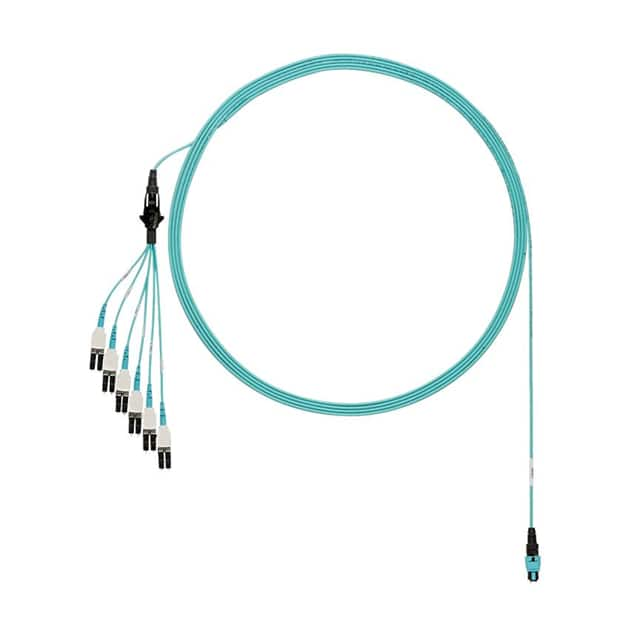
When working with the OM3 12-fiber round harness cable, such as the Panduit Corp SKU FXTRL8NUFSNM002, field issues typically arise from mechanical stress, contamination, or improper handling. This guide is based on real-world debugging scenarios and focuses on practical troubleshooting steps.
Typical failure modes and their root causes include intermittent or total loss of optical signal. The most common root cause is fiber breakage due to excessive bending below the minimum bend radius (typically 10x the cable diameter for OM3). Another frequent issue is connector end-face contamination, often from dust, oils, or improper cleaning. Attenuation exceeding the loss budget can also occur from crushed cables or pinched fibers during cable routing. Additionally, polarity errors are common where the transmit and receive fibers are swapped, especially in complex harnesses with multiple pairs.
A step-by-step debugging methodology should start with a visual inspection. Examine the entire cable length for kinks, crushing, or sharp bends. Use a fiber inspection microscope (e.g., a 200x or 400x scope) to check all 12 connector end-faces for scratches, pits, or contamination. Next, perform a continuity test using a visual fault locator (VFL); a red laser source injected into one end will show breaks as red light escaping through the jacket. If no breaks are found, move to optical power measurement. Connect a calibrated light source at one end and an optical power meter at the other, using the correct wavelength (850nm for OM3 multimode). Compare measured loss to the manufacturer’s specification (typically ≤0.5 dB per connector pair). If loss is high, isolate the problem by testing each connector pair individually. Finally, use an optical time-domain reflectometer (OTDR) for long runs to pinpoint the exact location of a fault.
Common mistakes in schematic design and PCB layout often involve ignoring the cable’s minimum bend radius. Designers may route the harness too close to sharp edges or through tight grommets. Another mistake is failing to include strain relief at the connector entry points, leading to micro-bends. On the PCB side, layout errors include placing high-heat components near the fiber connectors, which can degrade the epoxy over time. Also, ensure that the transceiver or module pinout matches the cable’s polarity; it is easy to miswire a 12-fiber harness if the Tx/Rx pairs are not clearly documented.
How to verify component authenticity and quality is critical, as counterfeit or substandard cables are a growing issue. First, check the packaging and labeling. Genuine Panduit cables have a unique serial number and holographic seal. Use a fiber identifier to measure the core diameter; genuine OM3 is 50µm, while counterfeit often uses 62.5µm. Measure the insertion loss and return loss with a test set; authentic components meet strict IEC standards. Look for uniform color coding of the 12 fibers (blue, orange, green, brown, etc.) and ensure the connector polish is smooth under a microscope. If the cable is from an unknown supplier, compare it against a known good sample.
Measurement techniques and what test equipment to use are essential for accurate diagnosis. For optical power, use a power meter with a ±0.1 dB accuracy and a light source set to 850nm for multimode. For loss testing, a two-meter reference cable is required to establish a baseline. An OTDR with a 850nm multimode module is ideal for locating faults in longer runs, but its dead zone may hide issues near the connector. A fiber microscope with both a video display and a USB output helps document contamination. For electrical continuity in active systems, use a multimeter to check the transceiver’s bias voltage. Always use patch cords with the same connector type (usually LC or MPO) to avoid mismatches.
When to suspect the component vs. the surrounding circuit depends on the symptom. If you see intermittent signal loss only when the cable is moved, suspect the cable itself—often a broken fiber near a connector. If the loss is consistent but high, check the connectors first. If the signal is completely absent but the VFL shows no break, suspect a polarity error or a bad transceiver. If the issue occurs only after the system is powered on, look at the electrical side: check the transceiver’s supply voltage and the host PCB’s signal integrity. A good rule is to test the cable with a known-good transceiver and a known-good power meter; if the cable passes, the problem is likely in the surrounding circuit.
Real-world case studies of common problems and solutions illustrate these points. In one case, a customer reported 3 dB loss on a 12-fiber harness. Inspection revealed a single fiber had a microscopic crack near the connector boot, caused by over-tightening the cable tie. The solution was to replace the harness and use velcro straps instead. Another case involved intermittent errors in a data center. The root cause was a dirty MPO connector on the harness, which was cleaned with a one-click cleaner. In a third example, a design team found that the cable’s polarity was reversed in their schematic. They had assumed a standard pinout, but the Panduit harness used a different keying. The fix was to re-label the PCB connectors to match the cable’s actual polarity. Finally, a field engineer encountered high attenuation in a new installation. An OTDR showed a sharp bend 10 meters from the patch panel, which was caused by a cable being routed over a sharp metal edge. The solution was to add a protective grommet and re-route the cable with a larger bend radius.
Always document your findings and retest after any repair. By following this structured approach, you can efficiently resolve most issues with OM3 round harness cables.