1212J-NSK Bearing Datasheet: Key Specs & Applications
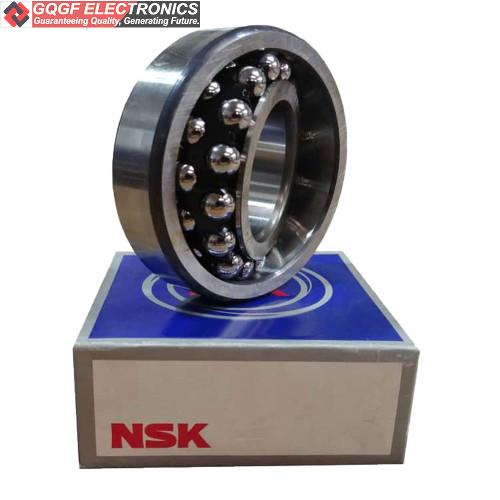
The 1212J-NSK is a precision mechanical component, specifically a double-row self-aligning ball bearing, rather than a semiconductor or active electronic device. Consequently, a traditional datasheet interpretation focusing on electrical specifications must be translated into the language of mechanical load, speed, and lubrication. For an electronics engineer, this component is best understood as a precision mechanical interface that ensures the reliable rotation of a shaft within a fixed housing, directly impacting the thermal and vibrational performance of the overall system. The primary "specifications" are not volts and amps, but dynamic load ratings, limiting speeds, and dimensional tolerances.
The most critical performance parameter is the dynamic load rating (Cr), typically expressed in kilonewtons (kN). For the 1212J, this value is approximately 30.5 kN. In practice, this figure represents the load under which a statistically significant population of bearings will achieve a rated life of one million revolutions. It is not a static maximum; it is a fatigue life predictor. When designing a motor or gearbox, you must calculate the equivalent dynamic bearing load (P), which combines radial and axial forces, and then apply the standard life equation L10 = (Cr/P)^3 (in millions of revolutions). A common error is to select a bearing based solely on the static load rating. For applications with high vibration or shock loads, the static load rating (Cor), approximately 21.6 kN for this model, is the limiting factor, as exceeding it can cause permanent brinelling of the raceways, leading to immediate acoustic noise and premature failure.
The limiting speed is the mechanical analogue of an absolute maximum rating. For the 1212J with oil lubrication, the limiting speed is around 6300 RPM; with grease, it drops to 5300 RPM. This is not a derating curve for voltage, but a derating curve for lubrication and centrifugal force. Operating above this speed causes the rolling elements to be thrown outward by centrifugal force, increasing internal stress and generating excessive heat. Just as with a semiconductor, you must derate for temperature and load. A higher radial load at high speed will increase the operating temperature, which in turn degrades the grease, reducing its life and leading to seizure. Practical derating involves reducing the applied load if the application runs continuously at speeds above 70-80% of the grease limiting speed.
In a typical application circuit analogy, consider a brushless DC motor driving a conveyor pulley. The bearing is the interface between the rotating rotor shaft and the stationary motor housing. The "circuit" is the load path: the belt tension (radial load) and any misalignment (axial load) flow through the shaft, into the bearing, and finally into the housing. The self-aligning feature of this bearing is its key advantage. It permits an angular misalignment of the inner ring relative to the outer ring of up to 2 to 3 degrees without causing a significant reduction in life. This is analogous to a compliant connector pin that tolerates pin-hole misalignment on a PCB. In practice, this means you can use it in a housing with less precise machining tolerances, or where shaft deflection under load is expected, without the risk of edge-loading stresses that would destroy a rigid ball bearing.
The "pin configuration" here refers to the mounting dimensions and internal clearance. The bearing has a 60mm bore, 110mm outside diameter, and 22mm width. The standard internal clearance for the 1212J is the C0 (normal) group, but variants like C3 (increased clearance) are available. This is critical for thermal management. In operation, the bearing will run hotter than the shaft, causing the inner ring to expand. A C0 clearance is suitable for normal temperature differentials (10-20°C). If the system runs hot, say a gearbox casing at 90°C while the shaft is cooler, you must select a C3 clearance to prevent the bearing from preloading itself to destruction. The mounting fit is the "soldering" of this component. A press fit (e.g., j5 or k6 for the shaft, M7 for the housing) is analogous to a tight solder joint ensuring no micro-movement; a loose fit (g6) is akin to a socket that allows for thermal expansion but risks fretting corrosion.
Thermal management is not about a heatsink, but about lubrication. The grease is the thermal transfer medium. Operating temperatures above 100°C will cause standard lithium-based grease to degrade exponentially. For every 15°C rise above 70°C, the grease life is halved. The characteristic curves in the datasheet, typically the speed vs. load nomogram, must be read as follows: locate the applied load on the X-axis, trace vertically to intersect the curve for your specific speed, and read the resulting L10 life on the Y-axis. A steep vertical descent in the curve indicates the threshold where film thickness becomes insufficient for elastohydrodynamic lubrication. Operating to the right of this knee is equivalent to operating a MOSFET beyond its SOA (Safe Operating Area); the bearing will suffer surface fatigue and spalling. Therefore, the final design check is to ensure the calculated L10 life meets the system's MTBF requirements, considering that bearing failure is often the leading cause of motor failure, and thus its "datasheet" is the most critical document for long-term reliability.