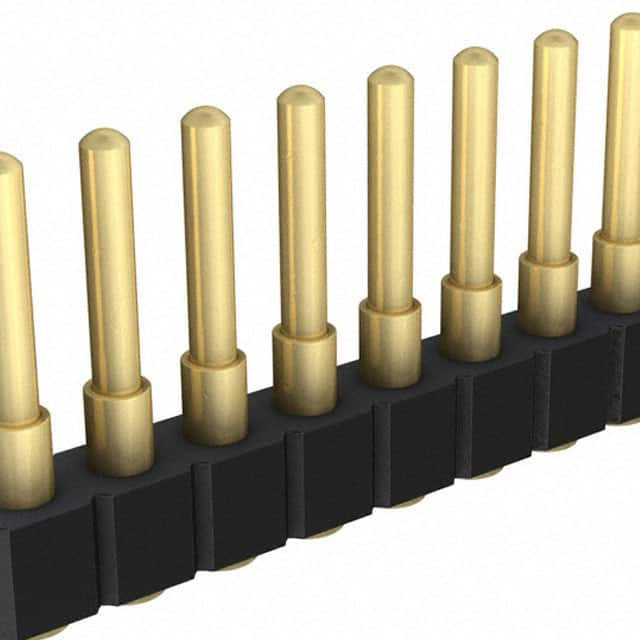
812-22-042-30-002101 vs. Rivals: SMD Piston Connector Guide
The component in question, the CONN SPRING PISTON 42POS SMD, belongs to the category of spring-loaded or pogo-pin connectors, specifically a board-to-board or board-to-device interface solution. Its role in electronic systems is to provide a reliable, separable, and low-profile electrical connection between a printed circuit board and a mating contact pad, often in applications where vibration, thermal cycling, or the need for repeated mating cycles preclude the use of rigid pin headers or soldered wires. The “piston” design refers to a plunger that compresses against a target pad, with an internal spring maintaining constant force, ensuring signal integrity even under mechanical stress or slight misalignment.
When selecting a spring piston connector, several key parameters demand attention. First is pitch and pin count—this 42-position, 0.8mm pitch part is optimized for high-density designs where board space is at a premium. Second is stroke or travel, typically 1.5mm to 2.5mm for this type; a longer stroke accommodates greater tolerance stack-ups but may increase mating height. Third is current rating, usually around 1-2 amps per pin for signal applications, and contact resistance, which should remain below 50 milliohms initially and stable over 10,000+ cycles. Fourth, operating temperature range (often -55°C to +125°C) and mating force (total force across 42 pins can be significant, affecting actuator or clamping mechanisms). Finally, plating material—gold over nickel is standard for corrosion resistance and low noise—and SMD soldering profile compatibility, as the part must withstand reflow without wicking solder into the spring mechanism.
Compared to alternatives such as mezzanine board-to-board connectors (e.g., 0.5mm pitch headers with sockets), spring pistons offer distinct advantages: they tolerate greater Z-axis misalignment (up to ±0.5mm) and do not require exact parallel mating, making them ideal for blind-mate applications or stacked boards with uneven warpage. They also handle higher mating cycle life—typically 50,000 to 100,000 cycles vs. 500 for conventional pin headers—and are less prone to damage from shock and vibration. However, they carry trade-offs: higher cost per pin (often 2-3x a standard header), lower current capacity (pogo pins are rarely rated above 5A, versus 3-5A for beefy pin headers), and a larger footprint per contact due to the spring barrel. Availability is generally good from specialty suppliers like Mill-Max, but lead times can stretch 6-8 weeks for non-stock variants; commodity pin headers are available off-the-shelf in days. For cost-sensitive, low-cycle, static applications, a simple friction fit is superior; for dynamic or high-reliability systems, spring pistons justify their premium.
Industry trends are pushing this category toward miniaturization and higher density, with pitches dropping from 1.27mm to 0.4mm, and pin counts exceeding 100 in some custom parts. Another trend is the adoption of hybrid connectors that mix spring-loaded signal pins with coaxial or power contacts for test-and-measurement equipment and 5G RF modules. Additionally, the shift toward automated optical inspection (AOI) and robotic assembly favors SMD spring pistons because they self-align during reflow, reducing placement errors. There is also growing demand for environmentally sealed variants (IP67) for industrial IoT and automotive under-hood applications, though this specific part is not sealed. Finally, the push for recyclability and RoHS compliance is driving manufacturers to eliminate lead-based solders and use beryllium copper springs, which this Mill-Max part already meets.
You should choose this specific 42-position SMD spring piston when your design requires high mating cycle reliability (e.g., battery contacts in portable medical devices, test fixtures for production lines), board-to-board stacking with loose tolerances, or field-replaceable modules where soldering a connector would prevent servicing. It is also the right choice when the PCB has no room for through-hole pins, and when you need a flat, pad-only interface on the opposing board—such as a flexible printed circuit (FPC) or a ceramic substrate—where a male header would crack the substrate. Avoid it if your assembly is purely static, if cost is the primary driver, or if you need high current (above 3A per pin) without parallelizing contacts.
From a procurement perspective, this Mill-Max part is a standard catalog item, so lead times are typically 4-6 weeks from order, with a minimum order quantity often around 50-100 pieces for distributors. Its lifecycle status is active and not for new design (NFFD) is unlikely—Mill-Max regularly supports this series for 10+ years, but always verify the latest PCN (product change notice) for plating or spring material changes. Second sourcing is challenging because the exact 42-position, 0.8mm pitch, 4.5mm height form factor is proprietary; however, drop-in alternatives exist from Preci-Dip (part 862-42-042-30-002101) and Ironwood Electronics (e.g., CBT-42-0.8MM), which match the same footprint and electrical specs, though they may have slightly different spring forces (e.g., 30g vs. 50g per pin). For high-volume production, negotiate a blanket order with Mill-Max to lock in pricing and avoid spot-buy premiums. Always request test data on contact resistance after 10,000 cycles to validate long-term performance, and ensure your reflow profile aligns with the part’s maximum temperature of 260°C for 10 seconds. If your project has a 5+ year lifespan, consider stocking a 10% buffer inventory, as this connector is unlikely to be obsoleted but may see a 20% price increase if raw material costs spike.
CONN SPRING PISTON 42POS SMD
Mill-Max Manufacturing Corp. | 812-22-042-30-002101 | $21.79