LVPECL XO Showdown: 590ED-CDG vs. Alternatives
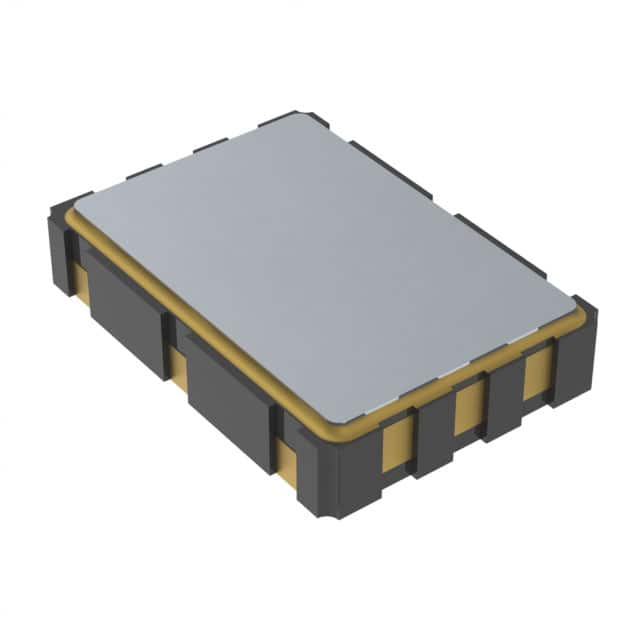
This component, identified by the SKU 590ED-CDG from Skyworks Solutions, belongs to the category of programmable crystal oscillators (XO) with a specific output logic standard. More precisely, it is a LVPECL (Low-Voltage Positive Emitter-Coupled Logic) oscillator operating at a nominal 2.5V supply. In an electronic system, its role is to provide a precise, low-jitter clock signal that serves as the timing reference for high-speed digital circuits, such as FPGAs, SerDes transceivers, network processors, and data converters. Unlike a simple resonator, an XO integrates the crystal and the oscillation circuit into a single package, ensuring a stable frequency without external tuning components. The LVPECL output is differential, meaning it delivers complementary signals, which offers superior noise immunity and sharp edge transitions—critical for long PCB traces and high-frequency operation above 100 MHz.
When selecting this type of component, the key parameters extend beyond the nominal frequency. Frequency stability is paramount; this part specifies 7 ppm, which measures how much the output frequency can drift over temperature, supply voltage, and aging. For comparison, standard XOs offer 20-50 ppm, while TCXOs (temperature-compensated) reach 0.5-2 ppm. Jitter, often expressed as phase noise or RMS jitter, is another critical metric, especially for high-speed serial links where timing margins are tight. For LVPECL parts, verify the output swing (VOH/VOL) and rise/fall times to ensure compatibility with the receiver’s input threshold. Supply current, start-up time, and enable/disable functionality (output tri-state) are also relevant for power-sensitive designs. Finally, the package footprint—this SKU likely comes in a standard 5x7mm or 3.2x5mm SMD—must match your PCB layout.
Comparing this specific Skyworks 590ED-CDG against alternatives reveals a balance of performance and flexibility. The most direct alternative is a fixed-frequency standard XO from vendors like Epson or TXC, which costs less and often has shorter lead times, but you lose the ability to change frequency. If you need lower jitter than 7 ppm stability implies, you might look at high-end OCXOs (oven-controlled), but those consume far more power and are significantly more expensive. Another alternative is a clock generator IC with an external crystal, which offers multiple outputs but requires careful PCB design for the PLL loop filter. In terms of cost, the Skyworks part sits in the mid-to-upper range for a programmable XO—typically 20-50% more than a fixed-frequency equivalent, but less than a full TCXO. Availability is generally good, as Skyworks maintains a strong distribution channel, but the programmable nature means it might have a minimum order quantity (MOQ) higher than fixed parts.
An important industry trend affecting this category is the shift toward higher frequencies and lower voltages. As data rates in networking and computing approach 112 Gbps per lane, the need for sub-100-femtosecond jitter clocks grows. LVPECL, historically popular, is being challenged by LVDS (Low-Voltage Differential Signaling) and HCSL (High-Speed Current Steering Logic) for lower power consumption. However, LVPECL still offers the largest voltage swing and best phase noise at high frequencies, which is why many high-performance FPGAs still specify it. Another trend is the move toward programmability on demand—instead of stocking dozens of fixed-frequency SKUs, distributors and OEMs are increasingly using programmable oscillators like this one to consolidate inventory. The 7 ppm stability is also notable; many competing programmable parts offer 10-20 ppm, so this part targets applications where temperature drift must be minimized without resorting to a TCXO.
You should choose this specific Skyworks 590ED-CDG when your design requires a precise, low-jitter LVPECL clock at 2.5V and you need the flexibility to change frequency without a PCB redesign. This is ideal for prototyping, multi-speed Ethernet switches (10/25/40/100G), broadcast video equipment, or test instruments where one board must serve multiple frequency variants. It is also a strong pick when your system operates in a wide temperature range (e.g., -40°C to +85°C) and the 7 ppm stability ensures the clock edge does not drift into timing violations. If you are using an FPGA with differential clock inputs, this oscillator provides a direct connection. However, if your design is a high-volume consumer product with a fixed frequency, a standard XO will save cost. If your jitter budget is below 300 fs RMS, you might need a dedicated low-jitter PLL, not an XO.
From a procurement perspective, there are several critical considerations. First, lead times for programmable oscillators from Skyworks typically range from 4 to 8 weeks, though during global semiconductor shortages this can stretch to 12 weeks. Check the distributor’s stock status; many B2B distributors keep safety stock of popular frequencies. Second, lifecycle status—this part is in active production, not NRND (Not Recommended for New Designs), which is a positive sign. However, always verify the PCN (Product Change Notification) history, as Skyworks occasionally changes internal crystal suppliers. Third, second-source options are limited because LVPECL programmable XOs with 7 ppm are a niche. SiTime offers comparable parts (e.g., SiT9102 series) but often in a different package and with different programming software. You can use a standard pin-compatible XO from Abracon or Ecliptek, but they may only offer 10-20 ppm. Therefore, for high-volume production, it is prudent to qualify a second source early. Also, note the programming voltage and I2C interface used to set the frequency—this part is programmed at the factory, so you must specify the exact frequency when ordering; you cannot field-program it. Work closely with your distributor to ensure the programmed frequency and stability grade match your purchase order.