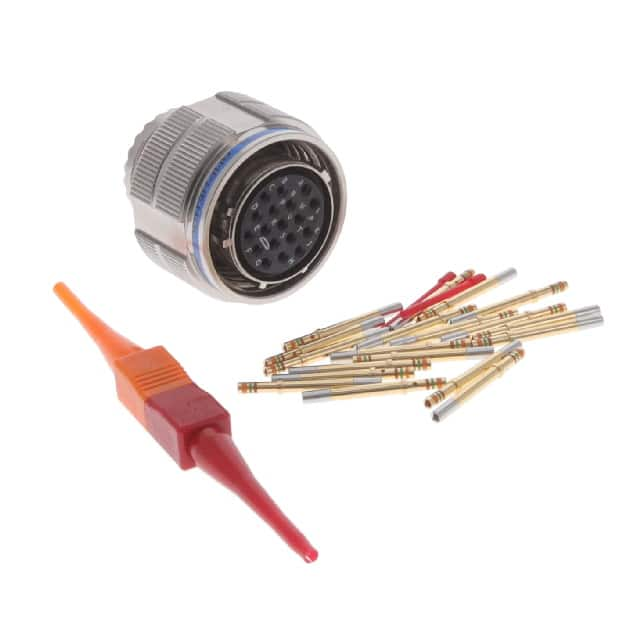
Unlocking Aerospace Connectivity: Inside the D38999/26FD18SN
The D38999/26FD18SN, a jam-nut receptacle connector from Amphenol Aerospace Operations, represents a critical nexus in modern electronics—a seemingly simple circular connector that embodies the stringent demands of military, aerospace, and industrial applications. With 18 gold-plated contacts arranged in a size D shell, this connector is far more than a physical interface; it is a reliability keystone in systems where vibration, temperature extremes, and electromagnetic interference are constant adversaries. For procurement professionals and design engineers, understanding this component’s trajectory is not just about inventory—it’s about strategic foresight.
The Technology Behind the Part and Recent Innovations
The D38999 series, governed by the MIL-DTL-38999 specification, has long been the gold standard for high-density, high-reliability circular connectors. The “FD18” configuration (size D shell, 18 contacts) utilizes a resilient silicone seal and a triple-start threaded coupling mechanism, ensuring a positive, anti-decoupling lock. The gold-plated contacts provide superior corrosion resistance and low contact resistance, critical for signal integrity in sensitive avionics and radar systems. Recent innovations in this space are not in the base geometry—the standard is mature—but in the materials and manufacturing processes. For instance, Amphenol has been integrating composite shell materials that reduce weight by up to 40% compared to stainless steel without sacrificing EMI shielding. Additionally, the adoption of automated crimping and terminal position assurance (TPA) systems has improved assembly consistency, reducing human error in field maintenance—a key driver for the military’s shift toward condition-based maintenance (CBM+) strategies.
Market Trends and Demand Drivers
The demand for MIL-DTL-38999 connectors, particularly the 18-position variants, is being propelled by three macro-trends: platform modernization, electrification of defense systems, and the expansion of commercial space. In defense, the U.S. Department of Defense’s focus on next-generation fighters (NGAD) and unmanned aerial vehicles (UAVs) demands connectors that can handle higher data rates and power levels in smaller footprints. The FD18SN, with its 18 gold contacts, is ideal for distributing power and signals in flight control computers and sensor pods. Simultaneously, the commercial aerospace sector is seeing a boom in narrow-body aircraft production, where each aircraft contains hundreds of these connectors in engine control, cabin management, and in-flight entertainment systems. The shift to more-electric aircraft (MEA) architectures is a potent driver—each actuator and motor controller requires robust, sealed interconnects that can handle high current while being immune to moisture and hydraulic fluids.
Supply Chain Dynamics: Sourcing, Lead Times, and Pricing
The supply chain for D38999 series connectors is a study in controlled scarcity. Because these components are manufactured to military specifications, they require stringent quality control and traceability, which inherently limits the number of certified suppliers. Amphenol Aerospace, along with peers like TE Connectivity and Cinch, dominate the market. However, lead times have fluctuated significantly in the post-pandemic era. In 2022-2023, lead times stretched to 40-60 weeks for certain shell sizes due to raw material shortages (specifically, aluminum and nickel alloys) and labor constraints in specialized plating facilities. As of 2024, the trend is stabilizing to a 20-30 week average for standard configurations like the D38999/26FD18SN, but pricing remains under upward pressure. The cost of gold, a critical contact material, has seen volatility, and the specialized passivation processes required for military-grade corrosion resistance add a 15-20% premium over commercial equivalents. Procurement teams should anticipate a 3-5% annual price escalation, driven not by demand but by regulatory compliance and energy costs in manufacturing.
Emerging Applications Driving New Demand
Beyond traditional aerospace, the D38999/26FD18SN is finding new life in hypersonic vehicle programs and advanced energy systems. Hypersonic flight requires connectors that can withstand extreme thermal cycles and high-vibration environments; the 38999’s triple-start thread and interfacial seal are uniquely suited for this. In the energy sector, the connector is being specified in offshore wind turbine pitch control systems and in electric vehicle (EV) battery test equipment, where its IP67-rated sealing (when mated) protects against salt spray and dust. Furthermore, the rise of military ground vehicles with advanced C4ISR (Command, Control, Communications, Computers, Intelligence, Surveillance, and Reconnaissance) systems is creating a parallel demand stream. These applications are pushing the envelope for higher pin counts and mixed-signal (power + fiber optic) configurations, but the 18-position, all-gold contact version remains a workhorse for analog sensor feedback loops.
Technology Roadmap: What’s Next for This Category
The roadmap for the D38999 category is not about replacing the standard, but augmenting it. The next phase involves “smart connectors” with embedded diagnostics. Amphenol and others are developing versions with integrated micro-sensors that monitor contact resistance and temperature in real-time, transmitting health data over the same wires used for power. This aligns with the military’s shift toward predictive maintenance, reducing unscheduled downtime. Additionally, we are seeing a push toward higher-bandwidth performance; while the current gold contacts handle Gigabit Ethernet, the next generation will need to support 10G and 25G for advanced radar and LiDAR data. This will require tighter impedance control and improved shielding, likely leading to a new suffix designation within the 38999 family. However, the legacy FD18SN will remain in production for decades due to the massive installed base—the challenge is ensuring backward compatibility with new, higher-speed backshells and accessories.
Impact of Industry Regulations
Compliance is a dual-edged sword for this component. On one hand, the MIL-DTL-38999 specification is a de facto global standard, simplifying cross-border design. On the other, European Union regulations like RoHS (Restriction of Hazardous Substances) and REACH (Registration, Evaluation, Authorisation and Restriction of Chemicals) are creating compliance friction. The gold plating itself is fine, but the cadmium plating used in some older shell variants for corrosion resistance is strictly limited under RoHS. Amphenol’s “SN” suffix indicates a cadmium-free, olive-drab chromate over cadmium alternative, which is RoHS-compliant but requires different handling and has a slightly different coefficient of friction. For automotive and industrial applications, the IATF 16949 certification is becoming a prerequisite, even for military-grade components, as the supply chain converges. Procurement teams must verify not just the part number, but the specific plating and finish compliance, as a mismatch can result in a product being blocked at customs or failing end-customer environmental audits.
Strategic Recommendations for Procurement Teams
For those sourcing the D38999/26FD18SN, the strategic imperative is to move from transactional buying to partnership-based inventory management. First, secure long-term agreements (LTAs) with authorized distributors that have direct factory allocation. Given the 20-30 week lead times, don’t rely on spot buys. Second, consider design-phase engagement: if your application allows, use the standard “SN” (cadmium-free) finish to avoid future RoHS exemptions lapsing. Third, implement a consignment inventory program for high-usage programs; this connector is a low-cost item (typically $40-$80), but a line-down due to a missing connector can cost thousands per hour. Finally, monitor the gold market as a proxy for pricing pressure. If gold prices spike, expect surcharges from manufacturers. By building a buffer stock of 4-6 weeks of critical demand and qualifying a second source (like a TE equivalent), you can mitigate the risk of single-source dependency and geopolitical disruptions in plating supply chains. This component is not a commodity—it is a strategic asset for mission-critical reliability.

CONN PLUG FMALE 18POS GOLD CRIMP
Amphenol Aerospace Operations | D38999/26FD18SN | $260.62