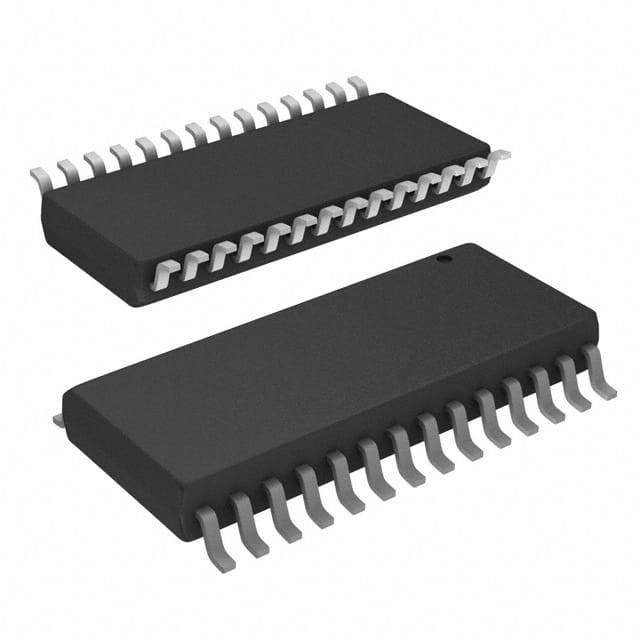
MAX211ECWI+ Reliability Guide: 28SOIC Transceiver Best Practices
Reliability Standards and Qualifications
The MAX211ECWI+ is a full-duplex RS-232 transceiver with 4 drivers and 5 receivers, housed in a 28-pin SOIC (W) package and manufactured by Analog Devices (formerly Maxim Integrated). This component is qualified per JEDEC standards, specifically JESD22 for environmental testing and JESD47 for stress-test-driven qualification. It is also compliant with AEC-Q100 for automotive applications where applicable, though the standard “EC” grade targets industrial temperature ranges (-40°C to +85°C). Key qualifications include moisture sensitivity level (MSL) rating—typically MSL-1 or MSL-2 for this package—and a lead-free finish (NiPdAu or matte tin) that meets RoHS and REACH directives. For high-reliability procurement, request the manufacturer’s qualification report, which documents results for HTSL (high-temperature storage life), THB (temperature-humidity-bias), and TC (thermal cycling) tests.
Accelerated Life Testing (ALT) and Interpretation
ALT for the MAX211ECWI+ typically involves HTSL at 150°C for 1000 hours, THB at 85°C/85% RH with bias, and TC from -55°C to +125°C for 1000 cycles. These tests accelerate failure mechanisms such as electromigration, corrosion, and die-attach fatigue. The Arrhenius equation is used to extrapolate results to use conditions (e.g., 55°C junction temperature). If no failures occur in a 1000-hour HTSL test, the implied activation energy (Ea) of ~0.7 eV suggests a projected life of over 20 years at 55°C. However, ALT results are only valid if the failure mode matches real-world stress; for RS-232 transceivers, ESD damage and latch-up are more common than thermal wear-out. Thus, ALT data should be viewed as a baseline for intrinsic reliability, not a guarantee against system-level electrical overstress.
Failure Rate Calculations (FIT and MTBF)
The MAX211ECWI+ typically exhibits a FIT rate (failures per 10^9 hours) of 5–20 at a junction temperature of 55°C, based on manufacturer data and industry handbooks like MIL-HDBK-217F or Telcordia SR-332. For a FIT rate of 10, MTBF (mean time between failures) is 1 / (10 failures per 10^9 hours) = 100 million hours. However, this MTBF is a statistical figure, not a “lifetime” guarantee—it assumes a constant failure rate during the useful life phase (after infant mortality, before wear-out). For procurement, use FIT rates to compare suppliers and to calculate system-level reliability (e.g., for a board with 10 such transceivers, total FIT = 100, giving a board MTBF of 10 million hours). Always derate FIT rates for higher temperatures: at 85°C junction, FIT may triple due to accelerated electromigration.
Environmental Stress Screening (ESS) and Burn-In
For high-reliability applications, ESS is recommended to weed out infant mortality. A typical burn-in for this IC is 48–168 hours at 125°C with dynamic biasing (inputs toggled, outputs loaded) and continuous monitoring for parametric drift (e.g., output voltage swing, quiescent current). Temperature cycling (-40°C to +85°C, 20 cycles) with functional testing at temperature extremes is also effective. However, burn-in adds cost and can itself induce damage if overstressed—especially for CMOS processes where latch-up risk increases at high temperature. For commercial-grade procurement, a 24-hour burn-in at 85°C with static bias is often sufficient. Document all ESS results with pass/fail criteria based on the datasheet’s electrical specifications (e.g., VOH > 5V, VOL < 0.2V, ICC < 15mA).
Counterfeit Detection Specific to MAX211ECWI+
Given its popularity, this transceiver is a target for counterfeiters. Key detection methods include: (1) X-ray inspection—verify die size, bond wire count (28 pins), and die attach consistency against known-good samples; genuine parts have a specific die layout for the MAX211. (2) Acoustic microscopy (CSAM)—check for delamination or voids in the epoxy mold compound. (3) Marking permanency and laser etch quality—counterfeits often have blurry or irregular logos, incorrect date codes, or missing “+” suffix. (4) Electrical testing—measure RS-232 output levels under ±5V supply; counterfeit parts may fail at -5V or show excessive skew. (5) Traceability—verify the lot code against Analog Devices’ database; if the lot is not found, it’s likely a grey-market or fake part. Always purchase from authorized distributors or via the manufacturer’s direct channel.
Incoming Inspection Best Practices
On receipt, perform the following: (1) Visual inspection per IPC-A-610 for package damage, bent leads, or foreign material. (2) Verify moisture barrier bag integrity—if the humidity indicator card shows >30% RH, the part may require baking at 125°C for 24 hours before reflow. (3) Sample electrical testing using a socketed test fixture—measure key parameters: quiescent current, output voltage swing, and receiver input hysteresis. (4) Check solderability per J-STD-002—the leads must wet within 2 seconds at 245°C. (5) For high-volume orders, perform a statistical process control (SPC) analysis on pin coplanarity and package dimensions. Document all results with a certificate of conformance (CoC) from the supplier. If any anomaly is found, quarantine the lot and contact the manufacturer’s field applications engineer.
Storage and Handling to Maintain Reliability
Store the MAX211ECWI+ in its original moisture-barrier bag at <30°C and <60% RH. The MSL rating dictates floor life—for MSL-2, parts can be exposed to ambient conditions for up to 1 year, but for MSL-3, only 168 hours. After opening, if the floor life is exceeded, bake at 125°C for 48 hours (or per IPC/JEDEC J-STD-033). Handle with grounded ESD-safe tools and wrist straps—this device is rated to ±15kV HBM ESD on I/O pins, but that does not make it immune to damage from improper handling. Avoid exposure to ultraviolet light for extended periods, as it can degrade the epoxy. For long-term storage (>2 years), use a dry cabinet with nitrogen purge and re-certify solderability before use.
End-of-Life and Obsolescence Management
The MAX211ECWI+ is an older design but remains in active production due to industrial demand. However, plan for obsolescence: (1) Maintain a 12–24 month buffer stock based on your consumption rate. (2) Identify a drop-in replacement—e.g., MAX211ECWI+T (same, but tape-and-reel) or the MAX211EAI+ (28 SSOP). (3) For legacy designs, consider a last-time buy (LTB) notification from Analog Devices, which typically gives 6 months’ notice. (4) If the part is discontinued, work with a qualified aftermarket supplier who can provide extended warranty and test services, but verify their ISO 9001 certification and counterfeit avoidance procedures. (5) Finally, design for alternate sourcing by using a socket or a second-sourced equivalent, such as the ADM211 or MAX211, which have similar pinouts—but always re-qualify for electrical performance and thermal profile. Proactive obsolescence planning ensures your product’s reliability over its entire lifecycle.
IC TRANSCEIVER FULL 4/5 28SOIC
Analog Devices Inc./Maxim Integrated | MAX211ECWI+ | $11.63