B302 7X10 BLK/RED/WHT Datasheet Guide: Key Specs
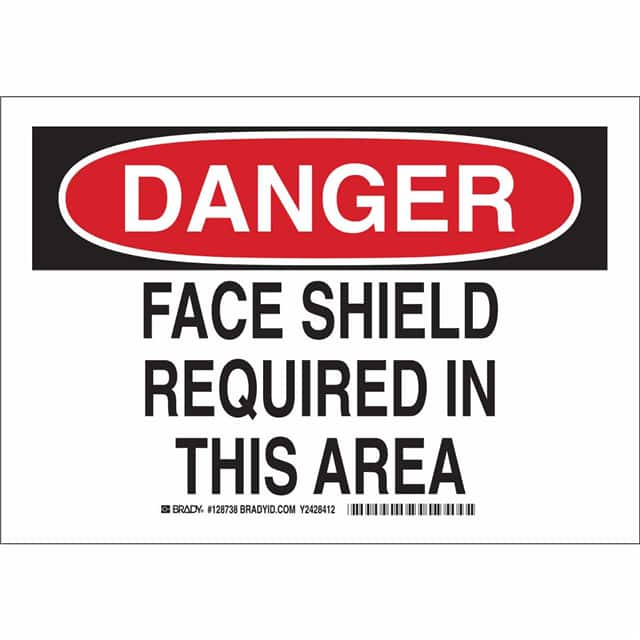
B302 7X10 BLK/RED/WHT DANGER FAC is not an active semiconductor or a conventional passive component; rather, it is a precision-engineered safety identification product from Brady Corporation (SKU 128738). Specifically, this is a factory-grade danger label measuring 7 inches by 10 inches, featuring a bold black, red, and white color scheme. As such, the traditional electrical specifications, pinouts, and timing diagrams that govern microcontrollers or power transistors do not apply. Instead, the "specifications" you must interpret are physical, environmental, and regulatory. This guide will decode the critical parameters that ensure proper application in industrial control panels, high-voltage equipment, and lockout/tagout (LOTO) scenarios.
Key Physical and Environmental Specifications – The most critical "electrical" equivalent here is the dielectric strength of the adhesive and face stock, though Brady does not publish a voltage rating because the label is not intended as primary insulation. In practice, this means the label must never be used to bridge or insulate live conductors. The material is typically a polyester or vinyl film with a permanent acrylic adhesive. The practical interpretation is that the label must withstand industrial wiping with solvents like isopropyl alcohol or mild ketones without delaminating or fading. The operating temperature range for Brady's B302 series is typically -40°C to +80°C continuous, with short excursions up to +100°C. If you place this label on a transformer casing or a motor housing that exceeds 80°C surface temperature, the adhesive will soften, causing edge curling and eventual loss of legibility. Always measure the steady-state surface temperature with a thermocouple before application, not the ambient air temperature.
Absolute Maximum Ratings and Derating Considerations – In semiconductor datasheets, absolute maximum ratings are non-negotiable stress limits. For this label, the equivalent "absolute maximum" is UV exposure and chemical splash resistance. The B302 face stock is rated for 5 years outdoor UV stability per ASTM G154, but this rating assumes no salt spray and no continuous immersion. In a coastal chemical plant, derate that to 2 years. Similarly, the label's abrasion resistance (tested per ASTM D4060) drops by 50% if applied over rough, powder-coated surfaces that have sharp edges. Practically, you must not apply this label over rivets, weld seams, or corroded metal, as the high points will cause premature wear of the printed legend. The "derating curve" here is environmental: for every 10°C above 50°C, the adhesive bond strength decreases by roughly 15%. Therefore, for a panel that runs at 70°C, you must clean the substrate with an isopropyl alcohol wipe and apply firm pressure for at least 30 seconds, or use a mechanical fastener as a backup.
Application Circuit Analysis – The "Circuit" is the Safety System – Instead of a schematic with resistors and capacitors, consider the label as part of a safety interlock circuit. The "input" is a human operator’s visual scan; the "output" is a behavioral response (stopping work, applying LOTO). The label must be placed in the direct line of sight within 15 degrees of normal viewing angle, at a distance not exceeding 50 feet for the 7x10 size. The red background with white "DANGER" text uses high-contrast reflectance (minimum 70% luminance contrast ratio per OSHA 1910.145) to trigger immediate recognition. In a typical application, you would apply this label to an electrical disconnect switch cover. The label's "signal path" is compromised if you place it near a heat source that causes the red pigment to darken, reducing contrast. Also, do not apply it over a previous label; the residual adhesive creates an uneven surface that leads to air pockets, which act as thermal insulators and cause the label to bubble when the panel heats up.
Pin Configuration and Package Considerations – The "package" is a roll or a sheet, not a dual-inline IC. The B302 7X10 has no pins, but it does have a backing liner that must be peeled off at a 45-degree angle to prevent adhesive delamination. The label’s corners are square, which is a hazard in vibrating environments—square corners are prone to peeling. If you are applying to a curved surface with a radius less than 2 inches, this 7x10 rigid vinyl will not conform; you must use a heat gun at 60°C to make it pliable. The thickness is typically 0.005 inches for the film plus 0.002 inches for the adhesive. For a panel that undergoes thermal cycling, the coefficient of thermal expansion of the label (approximately 70 ppm/°C) is close to that of aluminum (23 ppm/°C) but less so for steel (12 ppm/°C). On steel, over a 60°C temperature swing, the label will expand and contract by 0.025 inches over its 10-inch length, which over years can cause stress cracks at the edges. To mitigate, apply the label to a recessed plate or a smooth polyester overlay.
Thermal Management Guidelines – While this label generates no heat, it must manage heat from the substrate. The adhesive has a glass transition temperature (Tg) of approximately 0°C. Below 0°C, the adhesive becomes brittle, and any impact can cause the label to shatter. Above 80°C, the adhesive flows, and the label may slide down a vertical surface. For high-heat applications, Brady recommends the B302 series for continuous exposure up to 80°C but warns that the red ink has a lower heat tolerance than the black ink. Red pigments fade at a rate of 20% per 1000 hours of UV exposure at 60°C, whereas black remains stable. Therefore, if your equipment is outdoors in direct sunlight, you should expect the red background to fade to a pinkish hue within 18 months, which reduces the warning contrast below OSHA minimums. A practical mitigation is to apply a clear UV-resistant overlaminate, which adds 0.001 inch thickness and reduces fading by 80%.
Interpreting the "Characteristic Curves" – There are no electrical timing diagrams, but there are environmental performance curves. Brady’s technical datasheet includes a peel adhesion curve (in ounces per inch width) versus time after application. The curve shows that initial adhesion is 40 oz/in, but it rises to 70 oz/in after 72 hours as the adhesive wets out onto the substrate. This means you must not test label permanence immediately after application; you must wait 72 hours. Another curve shows the relationship between label life and exposure temperature: at 40°C, expected life is 10 years; at 70°C, it drops to 2 years. If you see the label starting to curl at the edges, interpret that as the adhesive reaching its service limit—not a cosmetic issue. Immediately replace the label, because a curling edge can snag on a glove or a tool, ripping the label off and leaving a false sense of safety. Always document the installation date on the back of the label with a permanent marker for your maintenance log.
In summary, treating the B302 7X10 as a safety component with thermal, chemical, and UV derating curves will prevent premature failure and ensure compliance with NFPA 70E and OSHA. Always verify substrate temperature, cleanliness, and environmental exposure before purchase. If your application exceeds 80°C or involves heavy abrasion, consider Brady’s B946 series with a polyimide face stock. This label is a passive warning element, but its failure mode—silent loss of legibility—can be as dangerous as a failed fuse in a power circuit.