OM3 Multimode Fiber Trends: Inside 10m LC/UPC-LC/UPC Cabling
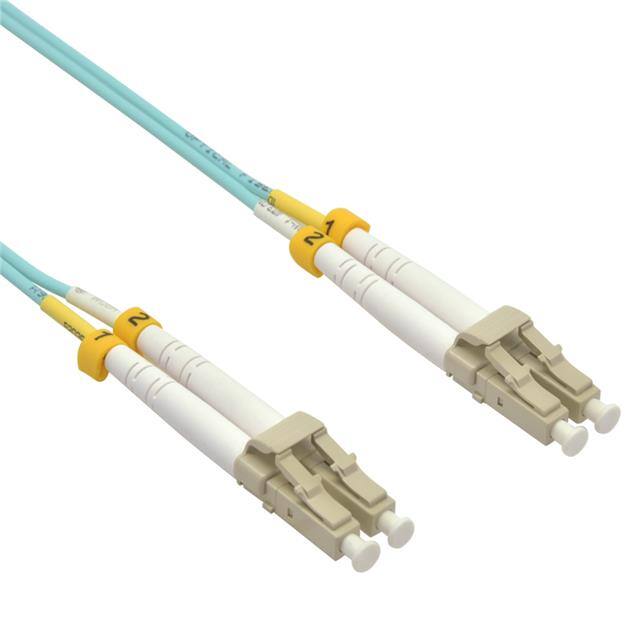
The 10m LC/UPC-LC/UPC OM3 multimode patch cable, distributed under the Coolgear brand as SKU CM-102619BSTK, sits at the intersection of several converging market forces. While it appears to be a commodity interconnect, this component is a useful bellwether for data center, enterprise, and industrial networking demand. Understanding its technology, supply chain, and roadmap provides procurement teams with actionable intelligence that extends well beyond a single SKU.
Technology and Recent Innovations
OM3 multimode fiber is a laser-optimized 50/125µm cable designed for 10 Gb/s transmission up to 300 meters and 40/100 Gb/s up to 100 meters using short-wavelength VCSEL optics. The LC/UPC connector—a 1.25mm ferrule with a physical contact polish—remains the dominant interface in high-density patch panels and SFP/QSFP transceivers. Recent innovations in this category center on bend-insensitive fiber, which reduces macrobend loss and enables tighter cable routing in crowded racks. Advanced jacketing materials, including low-smoke zero-halogen (LSZH) and plenum-rated compounds, are increasingly standard. Manufacturing improvements such as automated ferrule polishing and interferometric end-face inspection have pushed typical insertion loss below 0.15 dB and return loss above 35 dB, improving link margins in high-speed applications.
Market Trends and Demand Drivers
Demand for OM3 patch cords remains robust despite the growing adoption of OM4 and OM5. The primary driver is the massive installed base of 10G and 25G infrastructure in enterprise data centers, campus networks, and industrial environments. Hyperscale operators have largely migrated to OM4/OM5 for new builds, but colocation facilities, edge data centers, and secondary market deployments continue to specify OM3 for cost-sensitive 10G links. The AI and machine learning boom has created a parallel demand spike: while GPU clusters favor single-mode and OM4 for high-radix fabrics, OM3 remains widely used for management, out-of-band, and lower-speed aggregation layers. Pre-terminated 10m assemblies are particularly popular for rapid deployment, reducing installation labor by 60–80% compared to field-terminated solutions.
Supply Chain Dynamics
The global supply chain for OM3 patch cords is concentrated in China, Vietnam, and increasingly Mexico for North American distribution. Core raw materials—silica preforms, specialty polymers, and precision ceramic ferrules—are sourced globally, with ferrule production dominated by Japanese and Chinese suppliers. Lead times, which spiked to 12–16 weeks during 2021–2022 due to resin shortages and logistics disruptions, have normalized to 4–6 weeks for standard lengths. Pricing has stabilized after a 15–20% decline from peak pandemic levels, though copper and petrochemical volatility introduces periodic risk. The Coolgear CM-102619BSTK, as a branded, tested assembly, carries a modest premium over white-box equivalents, justified by consistent quality and warranty support. Buyers should monitor Chinese export policies and U.S. tariff schedules, as these can shift landed costs by 10–25% with little notice.
Emerging Applications
Beyond traditional data centers, several verticals are driving incremental demand. Industrial automation and Industry 4.0 deployments use OM3 for deterministic Ethernet on factory floors, where EMI immunity and distance capability outperform copper. Smart buildings and AV-over-IP systems increasingly rely on multimode fiber for 4K/8K video distribution. Healthcare imaging and military/aerospace applications value OM3 for its balance of bandwidth, latency, and ruggedized connector options. The emerging 5G small-cell backhaul market, particularly in dense urban environments, represents a growing opportunity for short-reach multimode links where single-mode installation is cost-prohibitive.
Technology Roadmap
The OM3 category faces a gradual but inevitable transition. OM4 and OM5 offer higher bandwidth and support for SWDM (shortwave wavelength division multiplexing), enabling 40G/100G over longer distances. However, the installed base and cost advantages of OM3 will sustain demand through at least 2030. Innovations to watch include reduced-diameter cables for higher patch-panel density, multi-fiber push-on (MPO) to LC breakout assemblies, and integrated testing capabilities such as embedded link-loss indicators. The long-term threat is the continued cost decline of single-mode optics, which could eventually erode multimode’s cost-per-gigabit advantage in new builds.
Regulatory Impact
RoHS and REACH compliance is non-negotiable for European and many global deployments. The Coolgear SKU meets these standards, but procurement teams must verify that alternate sources do not introduce restricted substances. For automotive and industrial applications, additional qualifications such as AEC-Q100 for transceivers and ISO 16750 environmental testing may apply to the complete link. Plenum-rated cables must meet NFPA 262, while LSZH jackets are increasingly required in European public infrastructure. Regulatory divergence—particularly around PFAS restrictions in the EU—could force reformulation of cable jackets, potentially affecting pricing and lead times.
Strategic Recommendations for Procurement Teams
First, dual-source this SKU across at least two qualified suppliers to mitigate geopolitical and logistics risk, but standardize on branded assemblies like Coolgear for critical links to ensure performance consistency. Second, negotiate long-term agreements with indexed pricing tied to raw material benchmarks, and consider buffer inventory of 6–8 weeks for lengths with lead times exceeding 4 weeks. Third, validate RoHS/REACH documentation annually and require supplier declarations for any automotive or industrial qualifications. Fourth, evaluate OM4 as a drop-in upgrade for new installations where the price delta is below 15%, as it future-proofs the link for 40G/100G. Finally, track single-mode optics pricing quarterly; when the cost crossover occurs, adjust the multimode share of your portfolio accordingly. The 10m OM3 patch cord remains a reliable, cost-effective workhorse, but strategic sourcing requires active management of its evolving role in the network hierarchy.