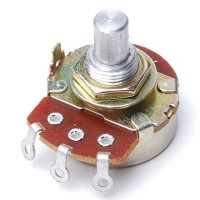
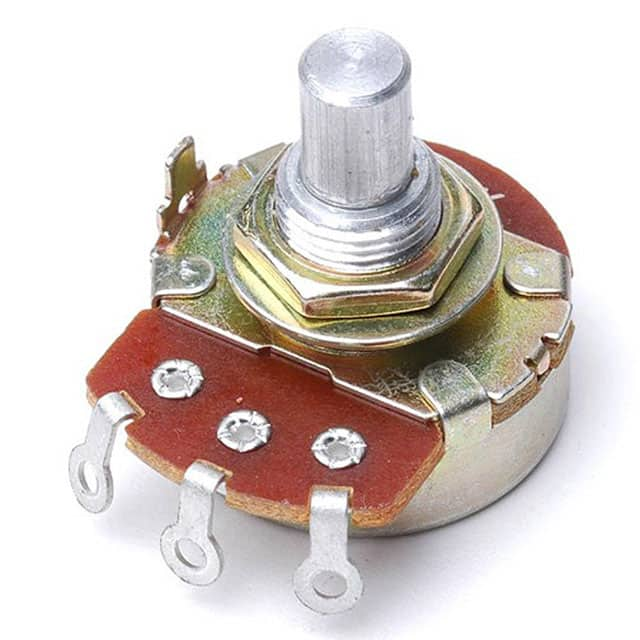
Troubleshooting the POT 1M OHM LINEAR (RV24A-10D2-15R1-B-1M)
The Xicon RV24A-10D2-15R1-B-1M is a 1M ohm linear taper carbon potentiometer in a 24mm body, commonly used for audio level control, bias adjustment, and sensor trimming. At 1M ohm, it is particularly sensitive to contamination, leakage, and layout parasitics, so many "failed potentiometer" reports actually trace back to the surrounding circuit. This guide covers what to check and in what order.
Typical failure modes and root causes. The most common failure is a noisy or intermittent wiper, usually caused by dust ingress, dried lubricant, or wear of the carbon track after thousands of rotations. A second common failure is an open track near one end, which happens when a user repeatedly slams the shaft against the mechanical stop. Third is a permanent resistance shift, where the element reads significantly above or below 1M ohm; this is often caused by moisture absorption in humid environments or by overheating during soldering. Finally, mechanical failure of the shaft or bushing occurs when the panel nut is over-tightened or the knob is forced. Note that carbon pots are not sealed, so conformal coating or a sealed alternative is required in wash-down or high-humidity products.
Step-by-step debugging methodology. First, disconnect power and measure end-to-end resistance between terminals 1 and 3. A healthy unit should read within roughly 20 percent of 1M ohm at room temperature. If it reads open or wildly off, the component is suspect. Second, measure from the wiper (terminal 2) to each end while slowly rotating the shaft through its full travel. The reading should change smoothly and monotonically from near 0 to near 1M ohm. Any jump, dropout, or crackling indicates a worn or contaminated track. Third, if the resistance curve looks correct but the circuit still misbehaves, reconnect power and measure the wiper voltage with a high-impedance meter while the circuit is operating. Compare against expected values from your divider math. Fourth, isolate the pot by lifting one leg and repeating the measurement; if the problem disappears, the fault is in the surrounding circuit, not the pot.
Common mistakes in schematic design and PCB layout. A frequent error is leaving the wiper floating when the pot is used as a rheostat; always tie the unused end to the wiper to prevent an open circuit if the wiper lifts. Another mistake is failing to add a series resistor at each end of the track when the pot sets a bias or feedback level, which means a wiper dropout drives the node to the rail. At 1M ohm, PCB leakage matters: flux residue, solder mask contamination, or moisture between traces can create a parallel path of several hundred kilohms, skewing the divider. Keep the wiper node short and guard it with a ground trace if the impedance is high. Do not run high-current or high-voltage traces under the pot body, and allow clearance for the metal bushing, which can short to a ground plane if the panel cutout is not isolated.
Verifying authenticity and quality. Counterfeit or relabeled pots are common in gray-market supply. Check the Xicon marking, the stamped resistance code, and the physical dimensions against the datasheet. Measure the end-to-end resistance at 25 degrees C and compare to the 1M ohm nominal with the stated tolerance. Rotate the shaft and feel for smooth, consistent torque; a gritty or loose feel suggests poor internal assembly. Inspect the terminals for plating quality and the carbon track for uniform color. If the part came from an unauthorized distributor at a suspiciously low price, treat it as suspect and qualify a sample batch before production.
Measurement techniques and test equipment. Use a digital multimeter with at least 10M ohm input impedance; a low-impedance meter will load a 1M ohm divider and give misleading readings. For noise and wiper continuity, an oscilloscope with a 10X probe is better than a DMM because it shows intermittent dropouts in real time. Apply a known DC voltage across the track and watch the wiper node while turning the shaft slowly. For temperature and humidity effects, use an environmental chamber and log resistance over time. A milliohm meter is not needed here, but a good LCR meter helps confirm the track is purely resistive rather than showing unexpected capacitance from contamination.
When to suspect the component versus the surrounding circuit. Suspect the pot when end-to-end resistance is out of tolerance, the wiper is noisy at a fixed position, or the track is physically damaged. Suspect the circuit when the pot measures correctly on the bench but fails in system, when the fault changes with temperature or humidity, or when multiple units fail identically. At 1M ohm, high-impedance nodes are the usual culprit, so check for flux residue, board cleanliness, and nearby switching noise before condemning the part.
Real-world case studies. In one audio product, a 1M ohm volume pot produced crackling only after the unit warmed up. Bench testing showed a clean track, but a scope on the wiper revealed a 50 kHz oscillation. The root cause was a long, unguarded wiper trace running parallel to a switching regulator; adding a 100 pF capacitor from wiper to ground and shortening the trace solved it. In another case, a batch of pots read 1.3M ohm out of the bag. The customer had stored them in a humid warehouse; baking at 60 degrees C for 24 hours brought them back within tolerance, confirming moisture absorption rather than a counterfeit. A third case involved a bias trimmer that drifted. The pot was fine, but flux residue under the body created a leakage path; a proper cleaning step fixed the drift.