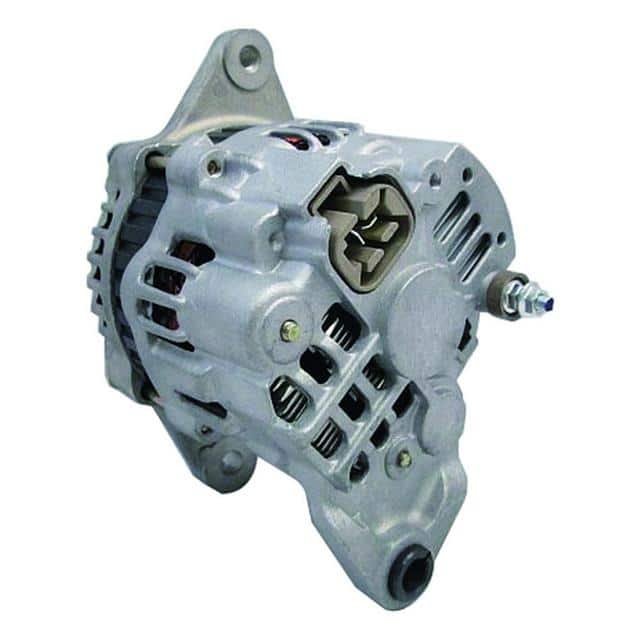
New Holland 1920 Alternator Datasheet Guide: 1996 Shibaura Diesel Replacement
The Interlight replacement alternator for the New Holland 1920 tractor, specifically the unit designated for the 1996 model year equipped with the 4-122 Shibaura diesel engine, is a critical charging system component that demands careful datasheet interpretation before installation. Unlike a generic alternator, this unit is engineered to match the original equipment manufacturer's electrical and mechanical interface. The most relevant electrical specification is the nominal output voltage, typically 12 volts DC in a negative-ground configuration, which directly corresponds to the tractor's battery system. The rated current output, often in the range of 40 to 55 amperes, determines the maximum charging capacity available to replenish the battery and power auxiliary loads such as work lights, instrumentation, and any aftermarket accessories. In practice, a higher current rating provides a safety margin for simultaneous loads but does not force current into the battery; the voltage regulator controls the field current to maintain a target charging voltage, usually between 13.8 and 14.4 volts at 25 degrees Celsius. Engineers must recognize that the alternator's output curve is not flat across engine speeds. At idle, the alternator may only produce 50 to 60 percent of its rated current, which is sufficient for maintaining a charged battery but insufficient for running high-draw accessories. The datasheet's characteristic curve, often plotted as output current versus rotor speed, is essential for predicting real-world performance during low-speed fieldwork.
Absolute maximum ratings define the boundaries beyond which the alternator will suffer permanent damage or degraded reliability. The most critical rating is the maximum continuous output current, which must not be exceeded even briefly without derating. For this unit, the rated current is typically specified at a rotor speed of 6,000 RPM and an ambient temperature of 25 degrees Celsius. Derating considerations become paramount in the engine compartment, where ambient temperatures can exceed 80 degrees Celsius. The datasheet may provide a derating curve showing that for every 10 degrees Celsius rise above the reference ambient, the maximum allowable output current decreases by 10 to 15 percent. Additionally, the maximum rotor speed, often 15,000 to 18,000 RPM, must never be exceeded, as centrifugal forces can destroy the rotor windings. Voltage transients, such as load dump events when the battery is disconnected while the alternator is charging, can produce spikes exceeding 100 volts and must be suppressed by the vehicle's electrical system or by internal avalanche diodes in the regulator. Engineers should also note the maximum reverse voltage rating for the rectifier diodes, typically 200 to 400 volts, and ensure that the charging system is never connected with reversed polarity.
The typical application circuit for this alternator is a three-wire or four-wire configuration. The main output terminal, often labeled B+ or BAT, connects directly to the battery positive terminal through a heavy-gauge cable, typically 8 or 6 AWG, to minimize voltage drop under high current. The voltage sense terminal, sometimes labeled S or sense, should be connected as close to the battery positive terminal as possible to compensate for cable losses. The field or excitation terminal, often labeled L or D+, connects to the charge indicator lamp on the dashboard. This lamp provides initial excitation current to the rotor through the regulator, allowing the alternator to begin charging at low speeds. Once the alternator is generating voltage, the lamp extinguishes as both sides of the lamp see approximately equal voltage. The ground terminal, if present, must be bonded to the engine block with a low-resistance connection. A common error is to omit the sense wire or connect it to the alternator output stud, which causes the regulator to undercharge the battery due to voltage drop in the output cable. The datasheet's application circuit diagram should be followed precisely, including any suppression capacitors or transient voltage suppressors recommended for the specific tractor model.
Pin configuration and package considerations are largely mechanical for this replacement alternator. The mounting flange pattern, pulley diameter, and belt offset must match the original Shibaura 4-122 diesel engine's accessory drive. The electrical connector, often a three-pin plastic housing, must mate with the tractor's existing harness without modification. The datasheet will specify the terminal assignments: typically a large stud for B+, a smaller spade or ring terminal for the sense line, and a two-pin connector for the lamp and ignition feed. The package is a standard automotive-style alternator with an internal voltage regulator and rectifier bridge. Engineers should verify that the replacement unit's dimensions, including the distance from the mounting face to the pulley centerline, are within a few millimeters of the original to avoid belt misalignment. The rotation direction, usually clockwise when viewed from the pulley end, must also match the engine's drive belt routing.
Thermal management guidelines are critical for long alternator life. The datasheet's thermal derating curve indicates that the alternator's maximum output current is valid only up to a specified ambient temperature, often 25 degrees Celsius. For every degree above that, the allowable current decreases. In a tractor engine compartment, radiant heat from the exhaust manifold and conduction from the engine block can raise the alternator's internal temperature well above ambient. To mitigate this, ensure that the alternator's cooling vents are not obstructed by debris, belts, or hoses. The internal fan, which draws air through the housing, must be intact and the air path clear. If the alternator is mounted near a turbocharger or exhaust pipe, consider adding a heat shield. The datasheet may also specify a maximum storage temperature, typically 85 degrees Celsius, which is relevant for units in inventory. During operation, the rectifier bridge and voltage regulator are the most heat-sensitive components; their junction temperatures must not exceed 150 degrees Celsius. Proper belt tension is also a thermal factor, as a slipping belt reduces rotor speed and thus cooling airflow.
Interpreting the timing diagrams or characteristic curves requires understanding that most alternator datasheets present a single performance curve rather than a timing diagram. The characteristic curve plots output current on the vertical axis against alternator rotor speed on the horizontal axis, usually in revolutions per minute. The curve typically rises steeply from zero at about 1,000 RPM, reaches the rated current at 5,000 to 6,000 RPM, and then flattens or slightly declines at higher speeds due to magnetic saturation and increased losses. The datasheet may also show a family of curves for different ambient temperatures, illustrating the derating effect. For this Interlight replacement, the curve should be compared against the original New Holland specification to ensure that the charging system can support the tractor's electrical loads at typical operating speeds. A common mistake is to read the rated current as available at idle; the curve clearly shows that only a fraction is available at low RPM. Engineers should also look for a note on the voltage regulation set point, often given as a range such as 14.2 to 14.8 volts at 25 degrees Celsius and 5,000 RPM. This set point determines the battery's state of charge and must match the battery type, whether flooded lead-acid or absorbed glass mat. Finally, any transient response curves, if provided, show how quickly the alternator recovers from a sudden load application, which affects voltage stability for sensitive electronics.
Replacement for New Holland 1920
Interlight | 1920 YEAR 1996 4-122 SHIBAURA DIESEL ALTERNATOR | $160.93