Reliability Guide for VRN2BGPX5000 Pressure Independent Control Valves
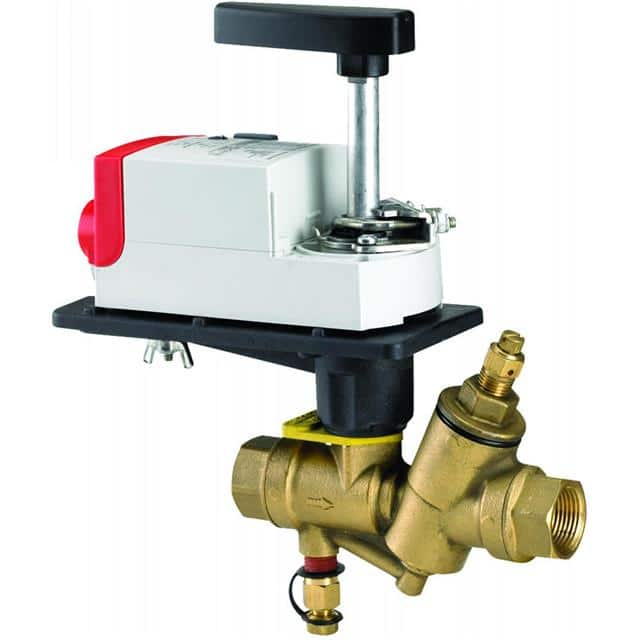
The Honeywell VRN2BGPX5000 is a pressure independent control valve (PICV) used in hydronic HVAC balancing and control loops. Because it combines a differential pressure regulator with a control valve in a single body, its reliability profile differs from that of a simple two-way valve. Buyers of this SKU are typically specifying for commercial buildings, district energy plants, or industrial process cooling, where a failure means lost comfort control or, worse, uncontrolled flow. The following guide addresses qualification, screening, failure-rate estimation, counterfeit risk, incoming inspection, storage, and obsolescence for this specific component.
Reliability standards and qualifications. The VRN2BGPX5000 falls under Honeywell's commercial HVAC valve family and should be qualified against ANSI/ASHRAE Standard 135 for BACnet integration when actuator electronics are involved, and against ANSI/FCI 70-2 for control valve seat leakage class. For pressure-independent performance, the relevant qualification is the valve's ability to maintain flow setpoint across a differential pressure range, typically 5 to 50 psi. Mechanical endurance should be verified to a minimum of 100,000 full-stroke cycles per ISO 5208 or equivalent. Where the valve is installed in potable water or closed-loop hydronic systems, compliance with NSF/ANSI 61 and 372 for wetted materials is expected. Buyers should request the manufacturer's declaration of conformity and any third-party witness test reports.
Accelerated life testing. For PICVs, accelerated life testing usually combines thermal cycling of the elastomeric diaphragm, mechanical cycling of the stem and plug, and pressure cycling of the regulator cartridge. A common accelerated profile runs the valve through 10,000 cycles at 1.5 times rated differential pressure and 60 degrees C water, which approximates 10 years of normal operation. Results are meaningful only when the failure mode is wear-out rather than random. If the test shows stem seal leakage or diaphragm creep after 10,000 cycles, the extrapolated life at rated conditions is roughly 50,000 to 70,000 cycles. Buyers should treat any accelerated life report that does not state the acceleration factor and the assumed field duty cycle as incomplete.
Failure rate and MTBF. Honeywell does not publish a FIT rate for the VRN2BGPX5000. A reasonable engineering estimate for a well-maintained PICV in a clean hydronic loop is a failure rate of 100 to 300 FIT, corresponding to an MTBF of roughly 380,000 to 1,140,000 hours. This estimate assumes constant failure rate and excludes installation error, water chemistry excursions, and actuator electronics. For procurement, the more useful metric is the probability of failure on demand over a five-year interval, which for 200 FIT is about 0.9 percent. Buyers should demand that any MTBF claim be accompanied by the data source, test conditions, and confidence level.
Environmental stress screening and burn-in. PICVs are mechanical assemblies and do not receive burn-in in the semiconductor sense. However, Honeywell and its distributors may perform a functional leak and flow test at the factory. For high-reliability orders, buyers can specify a screening protocol that includes a 24-hour hydrostatic hold at 1.5 times rated pressure, a 100-cycle stroke test at ambient, and a flow verification at three differential pressure points. This screening catches infant mortality from machining debris, incomplete diaphragm seating, and actuator calibration drift. Do not accept a certificate of conformance alone; require the actual screening data.
Counterfeit detection. Counterfeit PICVs are a real risk because the brass body and cartridge are easy to copy. Detection methods specific to this component include verifying the laser-etched or stamped Honeywell logo and SKU on the body, checking the actuator label for a valid serial number and date code, and confirming that the flow coefficient and pressure range match the published datasheet. Weigh the valve; counterfeit units often use thinner brass. Inspect the diaphragm material for the correct EPDM or EPDM-lined compound. Purchase only from Honeywell authorized distributors and request a certificate of origin with lot traceability.
Incoming inspection. Best practice is a three-tier inspection. First, visual and dimensional check of the body, ports, and actuator. Second, functional test at the specified flow setpoint and differential pressure range. Third, a sample disassembly for high-value orders to verify internal cartridge geometry and spring material. Keep inspection records tied to the purchase order and lot number. Reject any shipment with mixed date codes or damaged packaging.
Storage and handling. Store the VRN2BGPX5000 indoors at 5 to 40 degrees C and below 70 percent relative humidity. Keep the valve in its original packaging with port caps in place. Do not stack heavy items on the actuator. Avoid exposure to ozone, UV light, and solvents that degrade elastomers. Shelf life for the diaphragm and seals is typically five years from the date of manufacture; rotate stock accordingly.
End-of-life and obsolescence. Honeywell periodically revises valve platforms. Buyers should monitor product change notices and last-time-buy announcements. For this SKU, maintain a minimum of one year of spares plus a qualified alternate from a second source if the application is critical. Plan for form-fit-function replacement by verifying actuator compatibility, flow coefficient, and pressure range. Document the transition and re-qualify the replacement in the loop before the original stock is exhausted.