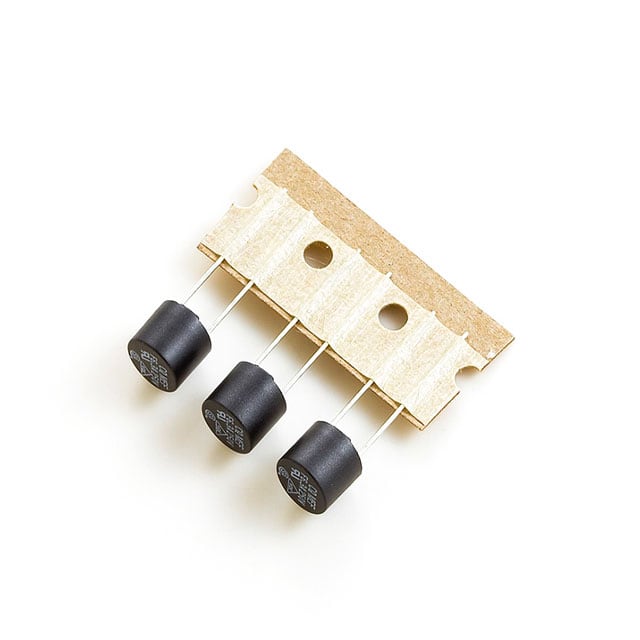
FXG-1.25A vs. Standard Fuses: 2.7x7.3mm Fast-Acting Comparison Guide
In the vast landscape of circuit protection, the humble fuse remains one of the most critical yet often overlooked components. The OptiFuse FXG-1.25A belongs to the category of subminiature axial-lead fuses, specifically a fast-acting (FAST) type with a 1.25A current rating and a compact 2.7mm x 7.3mm body. These components serve as the last line of defense against overcurrent events, sacrificing themselves to interrupt a circuit before downstream components—semiconductors, sensors, or power supplies—suffer catastrophic damage. Unlike resettable PTC devices, a fast-acting fuse offers a one-time, definitive break, making it ideal for applications where a hard fault must be cleared instantly and unambiguously.
When selecting a fuse like the FXG-1.25A, several parameters demand careful attention. Current rating is the most obvious: the 1.25A must exceed normal operating current but remain below the safe limit of the protected load. Voltage rating must meet or exceed the circuit voltage; the FXG series typically handles up to 250VAC or 125VDC, depending on agency approvals. Breaking capacity determines how much fault current the fuse can safely interrupt without rupturing—critical in mains-connected or high-energy DC systems. I²t value governs melting energy and coordination with other protection. Operating temperature derating is often ignored: a fuse rated at 1.25A at 25°C may only carry 1A at 70°C. Finally, physical size and mounting—here, a 2.7x7.3mm axial leaded body—dictate PCB layout and whether through-hole or surface-mount assembly is used.
Compared to alternatives, the OptiFuse FXG-1.25A occupies a useful middle ground. Slower-blow fuses (e.g., time-lag types) tolerate inrush currents from motors or transformers but respond too slowly to protect sensitive ICs. Resettable PTCs avoid replacement but have higher resistance, temperature sensitivity, and limited voltage ratings. Ceramic-body fuses offer higher breaking capacity but cost more and may be physically larger. Glass-body fuses are cheaper but can shatter under high fault energy. The FXG series uses a ceramic or epoxy-coated body for robustness, and its fast-acting characteristic suits resistive or semiconductor-heavy loads. In terms of cost, OptiFuse products are competitively priced—typically $0.10–$0.25 in volume—undercutting Littelfuse or Bel Fuse equivalents by 15–30% while maintaining UL/CSA recognition. Availability is generally strong through distributors like Digi-Key, Mouser, and Newark, though smaller axial fast-acting fuses have seen tighter supply than SMD chip fuses.
Industry trends are reshaping this category. Miniaturization pushes designers toward 0402 or 0603 surface-mount fuses, but through-hole axial parts remain essential for high-vibration, high-reliability, or legacy designs—automotive underhood, industrial motor drives, and medical power supplies. The shift to wide-bandgap semiconductors (SiC, GaN) demands faster fuses with higher breaking capacity, but many low-power circuits still rely on conventional axial types. Another trend is the move toward ecologically friendly fuses—RoHS-compliant, halogen-free, and lead-free construction. OptiFuse has kept pace, and the FXG series is RoHS compliant. However, the broader market sees consolidation: fewer manufacturers offer through-hole fast-acting fuses as SMD adoption grows. This makes second-sourcing more challenging but also makes stocking a proven part like the FXG-1.25A a strategic decision.
Choose the OptiFuse FXG-1.25A specifically when you need a fast-acting, compact, through-hole fuse for a low-to-medium voltage DC or AC circuit where board space is tight but automated SMD placement is not available or not desired. It excels in protecting sensitive analog front ends, small switch-mode power supplies, battery management systems, and instrumentation where a hard short must be cleared in milliseconds. It is also a good fit for prototyping and low-volume production because its axial leads allow hand soldering and easy replacement. Avoid it if your application experiences high inrush currents (use a time-lag fuse), requires resettable operation, or operates above 250VAC. For high-energy faults, a ceramic-body fuse with higher breaking capacity—such as the OptiFuse FXG-1.25A’s larger siblings or a Littelfuse 215 series—is safer.
From a procurement standpoint, the FXG-1.25A is an active, mature product with no published end-of-life notice as of this writing. Lead times have normalized to 4–8 weeks for factory orders, though distributor stock often ships same-day. Second-source options include Littelfuse 0251.1.25M (similar 2.7x7.3mm fast-acting), Bel Fuse 5SF 1.25-R, and Schurter FST 1.25A. However, cross-referencing requires verifying I²t, breaking capacity, and agency approvals—not just current and voltage. Because OptiFuse is a smaller supplier, some buyers hedge with a dual-approved design. Lifecycle status is stable, but the long-term trend away from through-hole fuses means buyers should monitor for discontinuance notices. For now, the FXG-1.25A offers a reliable, cost-effective balance of performance and availability, making it a smart default for fast-acting through-hole protection in compact electronics.