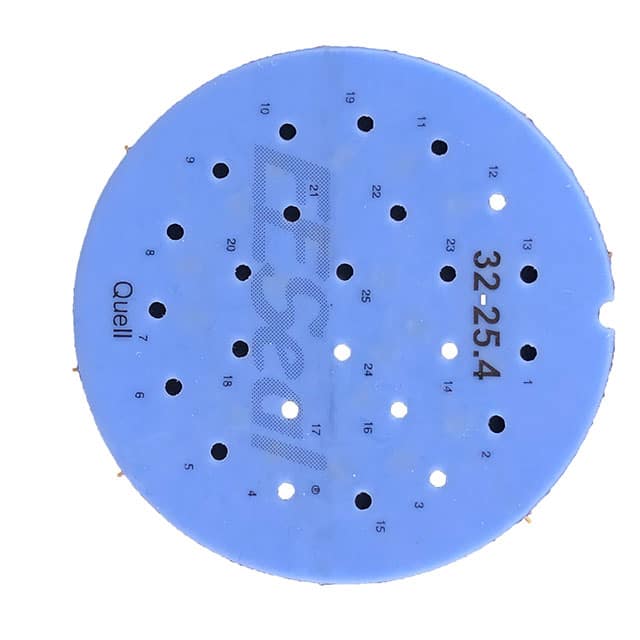
Filter Disk for MIL-DTL-38999 SE: Comparison Guide to FCQ38999/26ZJ8P
In the architecture of modern military and aerospace electronic systems, the integrity of signal and power transmission is paramount. The component at the center of this guide, the FILTER DISK FOR MIL-DTL-38999 SE (Brand: Quell, SKU: FCQ38999/26ZJ8PEMIL-STD-461), belongs to the category of EMI/EMP filter connectors and filter disk inserts. Specifically, it is a planar filter disk designed to be integrated into a MIL-DTL-38999 Series III or Series IV circular connector shell. Its role is to provide electromagnetic interference (EMI) filtering and transient protection at the point of entry into an enclosure, preventing unwanted noise from entering or leaving the system while ensuring compliance with MIL-STD-461 for conducted emissions and susceptibility. Unlike a standalone filter, this disk is embedded within the connector insert, saving space and simplifying assembly compared to discrete filter pins or external filter boxes.
When selecting a filter disk of this type, several key parameters dominate the decision. First is the capacitance value per line, typically measured in picofarads or nanofarads, which determines the cutoff frequency and insertion loss characteristics. The Quell disk is available in various capacitance codes, and the specific SKU FCQ38999/26ZJ8PEMIL-STD-461 likely corresponds to a defined capacitance and tolerance. Second, voltage rating and current capacity must match the signal or power lines it filters; exceeding these can lead to breakdown or thermal failure. Third, the insert arrangement and shell size must be compatible with the mating connector—here, the “26” in the SKU indicates a specific shell size and contact arrangement. Fourth, temperature range and environmental sealing are critical, as MIL-DTL-38999 connectors are expected to operate from -55°C to +125°C or higher, with resistance to shock, vibration, and moisture. Finally, MIL-STD-461 compliance is not just a marketing claim; it requires verified insertion loss data across the frequency spectrum, typically from 10 kHz to 10 GHz, and sometimes transient suppression for EMP or lightning effects.
Compared to alternatives, the Quell filter disk offers distinct trade-offs. Discrete filter pins or feed-through capacitors provide similar filtering but require more labor to assemble and occupy more space inside the connector. They may also introduce higher parasitic inductance, reducing high-frequency performance. External filter boxes or ferrite beads are cheaper for low-frequency applications but fail to meet MIL-STD-461 at higher frequencies or in harsh environments. Ceramic planar filter arrays from other brands, such as those from Spectrum Control or API Technologies, are direct competitors. Quell’s advantage often lies in custom capacitance values and faster prototyping for non-standard arrangements, but they may have higher unit costs for low volumes. In terms of availability, Quell maintains a niche but reliable supply chain; however, lead times can extend to 12–16 weeks for custom configurations, whereas standard catalog parts from larger competitors may be stocked in distribution. Performance-wise, Quell’s filter disks are known for low insertion loss in the passband and high attenuation in the stopband, but they are not inherently superior to premium alternatives—selection often hinges on mechanical fit and specific capacitance needs.
Industry trends affecting this component category are driven by three forces. First, miniaturization demands higher contact density within the same MIL-DTL-38999 shell size, pushing filter disk manufacturers to reduce thickness and improve dielectric materials. Second, higher frequency operation in radar, electronic warfare, and 5G military systems requires filter disks that maintain attenuation well into the Ka-band and beyond, challenging traditional ceramic formulations. Third, supply chain resilience has led to increased demand for second-source and drop-in replacements, as defense contractors seek to avoid single points of failure. Additionally, the shift toward commercial-off-the-shelf (COTS) plus modifications means buyers increasingly accept filter disks that meet MIL-STD-461 but are not fully qualified to the original MIL-DTL-38999 slash sheet, provided they pass equivalent testing.
You should choose this specific Quell filter disk over alternatives when your design requires a non-standard capacitance value or contact arrangement that off-the-shelf competitors do not offer, or when you need a fast turnaround on a small batch for prototype or legacy system support. It is also a strong candidate when your existing connector shell is already a MIL-DTL-38999 Series III and you want to add EMI filtering without redesigning the harness or increasing the connector footprint. However, if you are designing a high-volume production run with a standard 38999 insert arrangement, a catalog filter disk from a larger manufacturer may be more cost-effective and have shorter lead times. Similarly, if your application requires extreme high-frequency performance above 18 GHz, you should verify Quell’s insertion loss curves against specialty filter disks designed for millimeter-wave bands.
From a procurement perspective, the Quell FCQ38999/26ZJ8PEMIL-STD-461 is typically a made-to-order or build-to-print item, not a stock component. Lead times can range from 8 to 20 weeks depending on raw material availability and whether the capacitance value is standard. Lifecycle status is generally active, but because Quell is a smaller brand, you should confirm that the specific SKU has not been superseded by a newer revision. For second-sourcing, consider Spectrum Control’s SCI series or API Technologies’ filter connectors; both offer drop-in replacements for many 38999 filter disks, though you must cross-reference capacitance, voltage, and insert arrangement carefully. If second-sourcing is not possible, negotiate a last-time buy or consignment stock agreement to cover production gaps. Always request a Certificate of Compliance (CoC) to MIL-STD-461 and a qualification test report for the specific lot, as filter performance can vary between production runs. Finally, because this is a safety-critical component in many defense platforms, avoid unauthorized aftermarket equivalents that lack traceability to the original manufacturer.