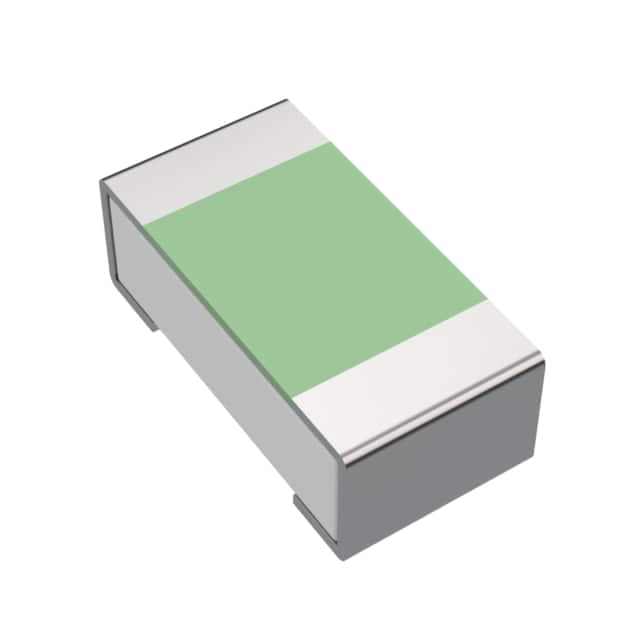
RES 24.3K OHM 0.1% 0402 Comparison Guide: TNPW040224K3BEED vs Alternatives
When selecting passive components for precision analog and mixed-signal designs, the thin-film chip resistor occupies a critical niche that few other technologies can fill. The Vishay Dale TNPW040224K3BEED, a 24.3 kΩ resistor with 0.1% tolerance and 1/16 W power rating in an 0402 package, represents a mature, high-precision solution within this category. Understanding where it fits—and where it does not—requires examining the technical and commercial trade-offs that define modern resistor selection.
Thin-film resistors like the TNPW series belong to the broader family of surface-mount passive components, but they are distinguished by their sputtered nichrome or tantalum nitride resistive layers, which are far more stable and precise than the ruthenium oxide thick-film pastes used in general-purpose chip resistors. In electronic systems, these components serve roles where signal integrity and measurement accuracy are paramount: voltage dividers in precision data acquisition front ends, gain-setting networks in instrumentation amplifiers, feedback loops in low-noise regulators, and reference chains in medical and industrial sensors. The 24.3 kΩ value is not arbitrary—it appears frequently in bridge circuits and filter topologies where specific ratios and impedance levels must be maintained across temperature and time.
Several parameters dominate the selection process for this component class. Tolerance is the most visible: 0.1% means the actual resistance deviates no more than ±24.3 Ω from nominal at 25°C, a level of precision that eliminates the need for costly trimming or calibration in many designs. Temperature coefficient of resistance (TCR) is equally important—the TNPW series typically offers ±25 ppm/°C, meaning that over a 100°C operating range, resistance shifts by only 0.25%. Long-term stability and load-life drift determine how much the value moves after thousands of hours under bias and thermal cycling. Power derating matters as well: the 1/16 W rating at 70°C must be linearly derated to zero at 155°C, and in an 0402 body, self-heating can introduce thermoelectric errors if layout is poor. Finally, noise—both current noise and excess noise—is lower in thin-film than thick-film parts, which is why precision audio and instrumentation designs favor them.
Compared to alternatives, the TNPW040224K3BEED sits in a premium but not exotic tier. General-purpose thick-film 0402 resistors with 1% tolerance cost a fraction of a cent in volume and are available from dozens of manufacturers, but their TCR is often ±100 ppm/°C or worse, and their long-term drift is unpredictable. Precision thick-film parts improve tolerance to 0.1% but rarely achieve the same TCR or stability. Wirewound and bulk metal foil resistors offer superior performance—TCR down to ±0.2 ppm/°C and essentially zero long-term drift—but they are physically larger, far more expensive, and not available in 0402. Thin-film is the sweet spot: enough precision for most instrumentation, in a size that supports dense PCB layouts, at a cost that is typically 5 to 20 times a standard thick-film part but still only a few cents each in production quantities. Availability is generally good for the TNPW series, though specific values and tolerances can experience allocation during demand surges.
Industry trends are reshaping this category. The push toward electrification and autonomous systems has increased demand for precision resistors in battery management, motor control, and sensor interfaces. At the same time, miniaturization continues: 0201 and even 01005 thin-film resistors are gaining traction, though 0402 remains the workhorse for precision because smaller sizes compromise power handling and TCR. Another trend is the integration of resistor networks and matched pairs in single packages, which improves ratio stability and reduces board space, but at higher cost and with less flexibility in value selection. Supply chain consolidation—Vishay, KOA, Panasonic, and a few others dominating the high-precision thin-film market—means buyers should monitor lifecycle status carefully. The TNPW series is mature and widely second-sourced in form factor, though not always in exact electrical specifications.
Choose the TNPW040224K3BEED specifically when your design requires better than 0.5% accuracy without calibration, when TCR below 50 ppm/°C is necessary for stable operation over temperature, or when long-term drift would compromise a measurement or control loop. It is also the right choice when board space is tight but you cannot accept the performance of a thick-film part. Avoid it when the application is purely digital or when a 1% resistor with ±200 ppm/°C drift is adequate—you will pay a significant premium for precision you do not need. In high-volume consumer products, the cost difference across thousands of units can be material; in low-volume industrial or medical instruments, the price premium is negligible against the cost of calibration or field failures.
From a procurement standpoint, the TNPW040224K3BEED is an active, catalog-standard part, but buyers should verify lifecycle status directly with Vishay or authorized distributors, as the TNPW family has seen some value-specific discontinuations over the years. Lead times for precision thin-film resistors typically range from 8 to 16 weeks, extending during periods of broad passive component tightness. Second-source options include KOA's RN73 series, Panasonic's ERA series, and TT Electronics' WIN series, but exact equivalents in 24.3 kΩ, 0.1%, and ±25 ppm/°C may not exist across all vendors. In those cases, designers can often substitute a 24.9 kΩ or 24.0 kΩ part if the circuit tolerates the value shift, or stack two resistors to achieve the target ratio. For critical programs, qualifying a second source early—and validating its TCR and stability—is prudent. Finally, because 0.1% tolerance parts are often tested individually, buyers should confirm whether the distributor stocks the exact tolerance code or if a 0.1% part is being sourced from a 0.5% production lot with screening, which can affect both price and reliability.