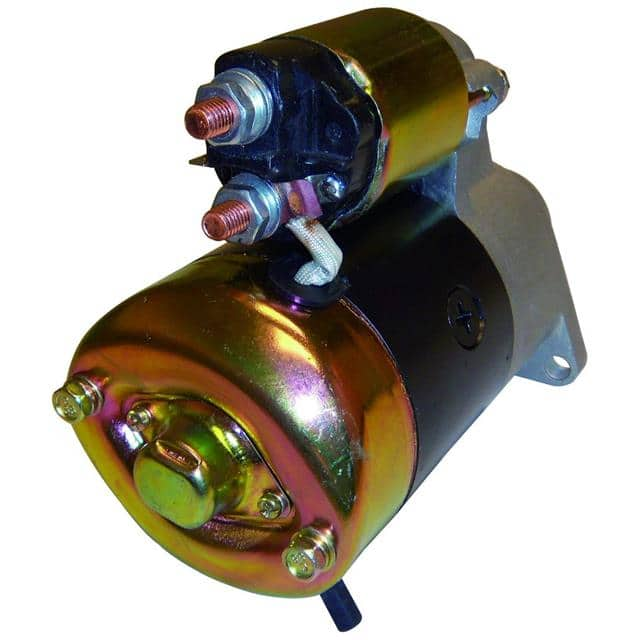
Kubota B7200HSD Starter Datasheet Guide: D950 17HP DSL Replacement
The Interlight replacement starter for the Kubota B7200HSD, identified by SKU B7200HSD YEAR 1988 KUBOTA D950 17HP DSL STARTER, is an aftermarket electromagnetic starter motor designed to crank the Kubota D950 three-cylinder diesel engine. Unlike a semiconductor datasheet, this component’s specifications are primarily electromechanical and must be interpreted with respect to the engine’s cold-cranking requirements, battery condition, and wiring integrity. The most critical electrical parameter is the nominal system voltage, which for this application is 12 V DC. However, the starter’s actual operating point depends on the battery’s state of charge and the voltage drop across the cables and solenoid contacts. A healthy 12 V lead-acid battery under load may deliver 9.5 to 10.5 V at the starter terminals during cranking; if the voltage falls below roughly 8 V, the starter will struggle to develop sufficient torque to overcome the diesel’s compression ratio of approximately 22:1. The locked-rotor current for this class of starter is typically in the range of 200 to 300 A, while the no-load current is usually between 60 and 90 A. These figures are not directly listed on the label but are essential for sizing battery cables and fuses. A cable gauge of 2 AWG or larger is recommended for runs under 1.5 meters to keep voltage drop below 0.5 V at 250 A.
Absolute maximum ratings for a starter motor are less about instantaneous voltage and more about thermal and mechanical limits. The starter must never be operated continuously for more than 30 seconds, as the armature and field windings will overheat and the commutator may deform. The absolute maximum duty cycle is typically 10% or less, meaning 30 seconds of cranking followed by at least 4.5 minutes of cooling. Exceeding this rating will degrade the insulation class (usually Class F or H) and shorten brush life dramatically. Derating is required when ambient temperatures exceed 40°C or when the starter is mounted in a confined engine bay with poor airflow. Under such conditions, the safe cranking time should be reduced to 15 seconds, and the cool-down period extended to 10 minutes. Also, the solenoid pull-in coil is not designed for continuous energization; if the ignition switch is held in the start position after the engine fires, the solenoid will overheat and may weld its contacts.
The typical application circuit for this starter is a standard three-wire configuration. The main battery positive cable connects to the large threaded terminal (usually 10 mm or 12 mm) on the solenoid. The solenoid’s pull-in and hold-in coils are internally connected to the small spade or ring terminal (typically 6.3 mm) that receives the start signal from the ignition switch. The starter motor’s field and armature are grounded through the starter housing to the engine block, which must have a low-resistance path back to the battery negative. A common failure mode is a missing or corroded engine-to-chassis ground strap, which forces return current through the throttle cable or fuel line, causing erratic cranking. Always verify that the ground strap has less than 0.1 Ω resistance. The solenoid also provides a bypass contact that supplies full battery voltage to the ignition coil during cranking, but on the D950 diesel, this is not used because the fuel shutoff solenoid is mechanical.
Pin configuration and package considerations are straightforward but critical for drop-in replacement. The Interlight unit features a cast aluminum nose cone with a two-bolt mounting flange that matches the Kubota D950 flywheel housing. The pinion gear has a specific number of teeth (typically 9 or 10) and a module that must mesh with the flywheel ring gear. The solenoid terminals are arranged with the battery stud at the top and the motor stud at the bottom, with the start signal terminal on the side. The overall package length and diameter must clear the exhaust manifold and engine mount. Before installation, compare the replacement starter’s mounting flange, pinion throw, and terminal orientation to the original. A mismatch in pinion engagement depth can cause excessive starter current draw or flywheel ring gear damage.
Thermal management is largely passive. The starter relies on conduction through its metal housing to the engine block and on convection from the engine bay. Do not wrap the starter in thermal insulation, as this traps heat. If the engine bay temperature routinely exceeds 90°C, consider a heat shield that reflects radiant heat from the exhaust but still allows air circulation around the starter body. The most important thermal guideline is to respect the cranking time limit. A diesel engine that does not start within 15 seconds of cranking has a fuel, compression, or glow plug problem—continuing to crank will only destroy the starter.
Finally, characteristic curves for this starter are typically presented as torque versus current and speed versus current. At 10 V and 200 A, the starter might produce 15 N·m of torque at 2000 RPM. As current increases to 300 A, torque rises to 25 N·m but speed drops to 1200 RPM. The curves are nearly linear in the normal operating region. When interpreting these curves, remember that they are measured at a fixed 20°C and with a fully charged battery. In cold weather, battery capacity drops and oil viscosity rises, moving the operating point to lower speed and higher current. Always use the curve at the lowest expected battery voltage (e.g., 8 V) to ensure the starter can still turn the engine over. If the curve shows insufficient torque at 8 V, the battery, cables, or starter itself must be upgraded.
Replacement for Kubota B7200HSD
Interlight | B7200HSD YEAR 1988 KUBOTA D950 17HP DSL STARTER | $140.30