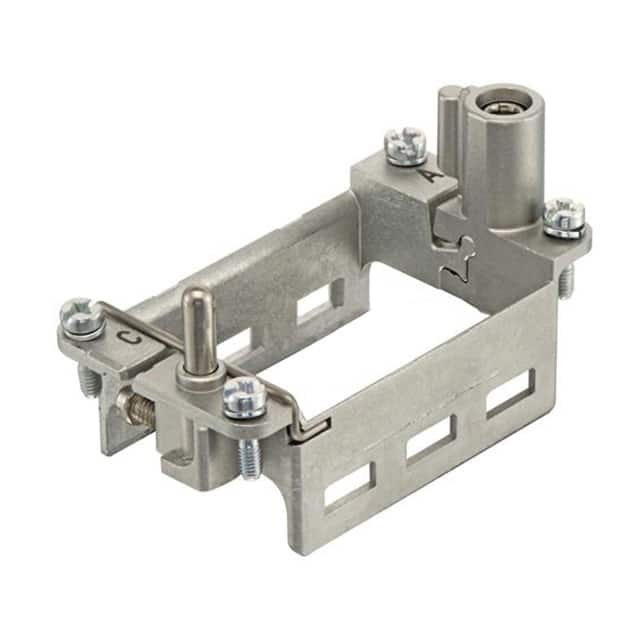
10B Modular Hinged Frame Plus S 09140100361 Reliability Guide
The HARTING 10B MODULAR HINGED FRAME PLUS (SKU 09140100361) is a Han-Modular hinged frame that mechanically retains and aligns modular inserts within a size 10B hood and housing. Because it is a passive, non-current-carrying mechanical interface, its reliability is governed primarily by mechanical endurance, material stability, and dimensional precision rather than by electrical degradation mechanisms. Procurement and quality teams should treat it as a safety- and function-relevant accessory: frame failure can cause insert misalignment, contact damage, or loss of IP protection at the interface.
Reliability standards and qualifications. The frame should be qualified against the core Han series standards: IEC 61984 (connectors — safety requirements and tests), IEC 60512 (electromechanical test methods), and the applicable HARTING product specification. Mechanical endurance is typically verified to 500 mating cycles per IEC 60512-9-1, with vibration and shock per IEC 60512-6 and IEC 61373 where rail or transport applications apply. Flammability should meet UL 94 V-0, and the frame material (typically polycarbonate or comparable engineering thermoplastic) should be rated for the stated operating temperature range, commonly −40 °C to +125 °C. For rail procurement, EN 45545-2 hazard-level ratings for the frame material should be confirmed on the manufacturer's declaration.
Accelerated life testing. For this frame, accelerated testing focuses on wear and thermal aging. Mating-cycle tests run at elevated rates to compress time; results should be interpreted as wear-rate data, not as a simple multiplier. A frame passing 500 cycles with acceptable retention force and no cracking supports the stated endurance claim, but field life depends heavily on alignment discipline during mating. Thermal aging (e.g., 1,000 h at rated temperature) evaluates embrittlement and loss of hinge retention. Any Arrhenius extrapolation should use conservative activation energies and be treated as indicative only.
Failure rates and MTBF. No credible FIT rate exists for a passive hinged frame; published connector FIT rates are dominated by contact and insulator data and do not transfer to this part. Do not accept vendor FIT numbers without a defined failure mode and test basis. For system MTBF calculations, model the frame as a mechanical item with a low, empirically derived failure rate — commonly below 1 FIT when properly applied — or exclude it and address it through mechanical FMEA. The dominant realistic failure modes are hinge fatigue, latch/frame cracking from mis-mating, and dimensional drift from thermal cycling.
Environmental stress screening and burn-in. Burn-in is not appropriate for this component and offers no reliability benefit. ESS, where used, should be limited to incoming sample verification: thermal cycling across the rated range and a short vibration sweep to detect molding defects or hinge cracks. Destructive screening of production lots is not recommended.
Counterfeit detection. Counterfeit frames are usually poor moldings or rebadged generic parts. Verify laser-etched or molded HARTING markings and the SKU against the current datasheet; check mold texture, gate locations, and part-number font consistency against a known-good reference. Confirm packaging, labels, and date/batch coding with HARTING or an authorized distributor. Dimensional verification of hinge geometry and insert retention is the most reliable functional check; suspect lots should be quarantined and reported through the appropriate anti-counterfeit channels.
Incoming inspection. Use a sampling plan (e.g., ISO 2859-1, AQL 0.65–1.0 for major defects). Inspect markings, material color and finish, hinge freedom, latch engagement, and fit with a reference 10B insert and hood. Verify dimensions against the drawing at key interfaces. Retain first-article and periodic full-dimensional reports. Document supplier, lot, and date code for traceability.
Storage and handling. Store in original packaging in a cool, dry environment (typically 5–30 °C, below 70% RH), away from direct sunlight, ozone sources, and solvents. Avoid stacking loads that deform frames. Handle by the frame body, not the hinge, and never force inserts. Observe shelf-life guidance for the polymer; extended storage beyond several years warrants a functional sample check before use.
End-of-life and obsolescence. Monitor HARTING product-change and discontinuation notices and maintain a last-time-buy buffer sized to your qualification and spares needs. Identify approved alternates within the Han-Modular family and pre-qualify them dimensionally. Track lot date codes so aged stock is consumed first, and plan redesign only if the frame family is withdrawn.