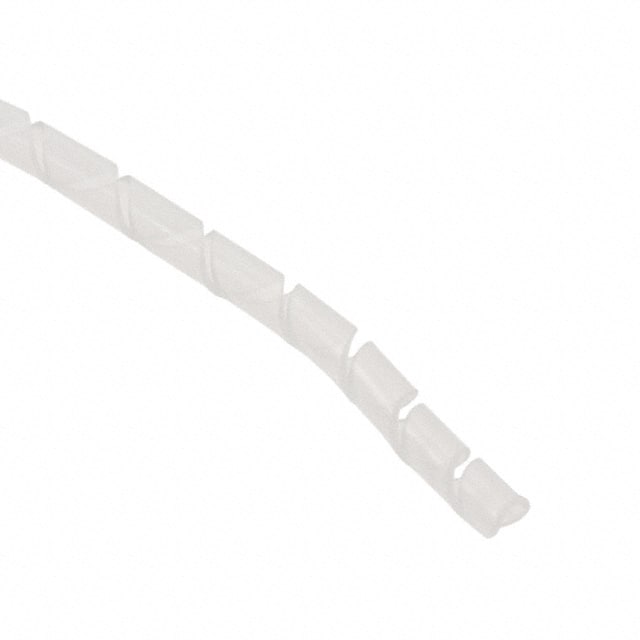
SPIRAL WRAP 0.2" X 100' Natural: Industry Insight on Cable Management
Spiral wrap—the humble slit-tube cable bundling solution—rarely makes headlines, yet it remains one of the most specified consumables in any wire harness or panel build. The Alpha Wire SW21 NA005, a 0.2-inch diameter, 100-foot reel in natural polyethylene, is a representative workhorse SKU in this category. Understanding its technology trajectory, demand drivers, and supply dynamics offers a useful lens on the broader cable management accessories market.
Technology and recent innovation. Traditional spiral wrap is extruded from polyethylene (PE) or nylon, slit helically so it can be wound around existing bundles without disconnecting terminations. The SW21's natural PE formulation balances flexibility, abrasion resistance, and cost. Recent innovations in this segment center on material upgrades and functional additives: flame-retardant grades meeting UL 94 V-2 and V-0, UV-stabilized compounds for outdoor and solar installations, and halogen-free, low-smoke formulations for rail and transit. Manufacturers are also tightening dimensional tolerances and improving slit consistency to reduce snagging during high-volume harness assembly. Some suppliers now offer pre-cut lengths and kitted assortments to reduce installation labor—a meaningful value-add as assemblers grapple with skilled-labor shortages.
Market trends and demand drivers. Demand for spiral wrap tracks closely with wire harness production, which is growing steadily across industrial automation, robotics, EV charging infrastructure, and data center build-outs. The shift toward modular machine design has increased the number of discrete cable bundles requiring protection, while the proliferation of sensors and low-voltage control wiring in smart factories expands the addressable base. On the consumer and pro-AV side, the cord-management trend—driven by home office build-outs and commercial AV integration—sustains steady MRO-style demand. Distributors report that small-diameter sizes like 0.2 inch are among the highest-velocity items, reflecting their use in control panels and instrumentation bundles where space is tight.
Supply chain dynamics. Spiral wrap is a mature, highly commoditized product with manufacturing concentrated in North America, Europe, and Asia. Base resin availability—particularly PE and nylon—remains the dominant cost variable, and pricing has historically moved with polymer indices rather than with copper or semiconductor cycles. Lead times for branded product from established manufacturers such as Alpha Wire have generally normalized to stock-to-four-week ranges for standard colors and sizes, though non-standard colors, flame-retardant grades, and large reels can extend to eight weeks or more. The pricing outlook is modestly inflationary: resin costs, freight variability, and consolidation among extruders all point to low-single-digit annual increases, with sharper moves possible if polymer markets tighten. Buyers should watch for tariff exposure on Asia-sourced accessories and the growing availability of private-label equivalents that undercut branded pricing by 15–30 percent.
Emerging applications. Beyond traditional panel and harness work, several applications are adding demand. EV charging installations require organized, abrasion-resistant cable routing in both the charger cabinet and the cable management arm. Battery energy storage systems use spiral wrap to bundle sense and communication wiring in enclosures where flame-retardant grades are increasingly specified. Robotics and cobots drive demand for flexible, low-friction wraps that tolerate continuous motion. In data centers, spiral wrap is finding use in rear-cabinet cable organization as operators push for improved airflow and serviceability. Solar installers likewise use UV-rated spiral wrap for exposed DC runs.
Technology roadmap. The next several years will likely bring incremental rather than disruptive change. Expect broader availability of halogen-free and low-smoke-zero-halogen (LSZH) grades, expanded flame-retardant portfolios aligned with evolving UL and IEC standards, and growth in pre-cut and kitted formats that reduce field labor. Some manufacturers are exploring bio-based and recycled-content resins to support customer sustainability scorecards, though performance parity remains a gating factor. Automated harness assembly equipment may also drive demand for tighter-tolerance, machine-feedable wrap formats.
Regulatory impact. Spiral wrap is squarely in scope for RoHS and REACH, and most branded product is already compliant; the practical risk lies in documentation gaps from low-cost sources. For automotive and transportation customers, IATF 16949 and OEM-specific material specifications—including flammability, fogging, and outgassing requirements—raise the bar significantly, favoring established brands with full traceability. UL recognition (file number and flame rating) matters for equipment listed to UL 508A and similar standards. Procurement teams should treat compliance documentation as a qualification criterion, not an afterthought.
Strategic recommendations for procurement teams. First, dual-source branded and qualified private-label supply to protect against single-supplier disruption while retaining a compliant fallback. Second, standardize on a preferred material grade—natural PE for general use, FR or LSZH where mandated—to simplify inventory and avoid over-specification. Third, negotiate annual index-linked agreements tied to resin benchmarks rather than accepting spot pricing. Fourth, monitor lead times on non-standard colors and large reels, which are the most likely to stretch. Finally, evaluate kitted and pre-cut formats where labor savings outweigh unit-price premiums—in high-volume assembly, the labor math often favors the convenience product even at a higher piece price.