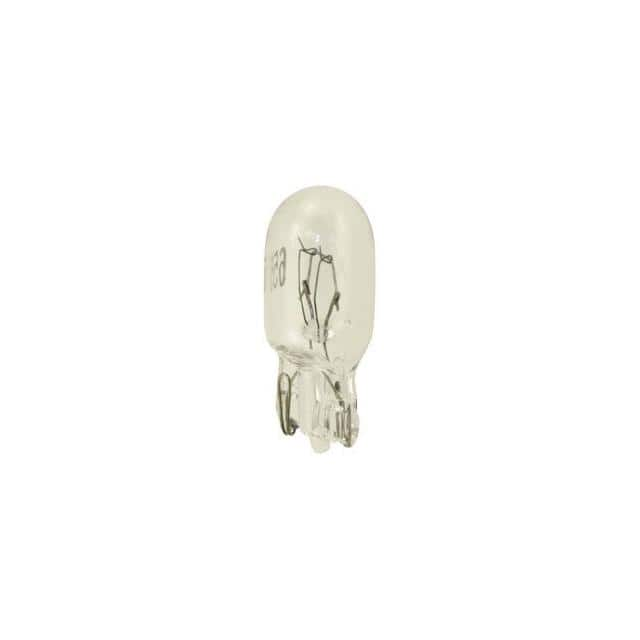
MINIATURE .27 AMPS 14V Wedge 5 Reliability Guide: 10PAK WW-AH1A-5
The Interlight 10PAK:WW-AH1A-5 is a miniature wedge-base incandescent lamp rated at .27 amps and 14 volts, supplied in a five-piece pack. Lamps of this class are consumable electro-optical components, and procurement teams should treat them with the same qualification discipline applied to active semiconductors. The dominant wear-out mechanisms are tungsten filament evaporation, hot-shock fracture, and envelope seal degradation; reliability planning must therefore center on rated-life verification, thermal derating, and lot-level screening rather than on generic IC-style qualification.
Reliability standards and qualifications. Incandescent wedge lamps are governed less by a single IECQ-style qualification than by a family of test standards. Relevant references include IEC 60810 (performance requirements for lamps for road vehicles), SAE J573 and J759 for automotive lamp categories, and ANSI C78 series documents covering lamp bases and dimensional interchangeability. For non-automotive professional use, buyers should require the supplier to declare conformance to the applicable wedge-base dimensional standard, rated life at design voltage, and lumen maintenance at end of life. Because Interlight distributes rather than manufactures, qualification evidence should include the original manufacturer's datasheet, a certificate of conformity per shipment, and traceability to the production lot.
Accelerated life testing. Life testing for this lamp type is typically run at elevated voltage, since filament life scales approximately with the inverse of applied voltage raised to a power between 12 and 16. A lamp rated for a nominal life at 14 V can be screened at 15.5 V to compress test time, with results back-extrapolated to the service voltage. Meaningful results require a sample of at least 20 to 30 pieces per lot, monitoring for catastrophic open-filament failure and for gradual output degradation. A Weibull fit should yield a shape parameter well above 1 for wear-out behavior; a shape parameter near 1 signals random early failures and indicates a manufacturing or handling problem rather than normal aging.
Failure rates and MTBF. For a consumable lamp, MTBF is a misleading metric because the hazard rate rises steeply with hours of operation. The more defensible approach is to compute a FIT rate over a defined operating window, for example failures per 10^9 lamp-hours during the first 500 hours at rated voltage, and to publish a B10 life figure (time at which 10 percent of a population has failed). Procurement specifications should state the operating voltage, ambient temperature, and switching duty assumed, because inrush current at cold filament can be ten times steady-state current and dominates early failure. Where a FIT figure is quoted by a distributor without test conditions, treat it as unverified.
Environmental stress screening and burn-in. Full burn-in is not economic for low-cost miniature lamps, but a short screening run is valuable. A practical protocol is a 1 to 2 hour burn at rated voltage with 100 percent visual and electrical check, plus a thermal cycling step between -40 °C and +85 °C on a sample basis to expose seal and filament support weaknesses. Vibration screening per a defined profile helps detect loose filament supports. Screening data should be retained by lot so that drift in early failure rates can trigger supplier corrective action.
Counterfeit detection. Counterfeits of miniature wedge lamps usually appear as dimensional deviations, incorrect filament geometry, or unmarked or misprinted bases. Incoming checks should include base width and height measurement against the standard, filament position inspection under magnification, glass envelope clarity, and verification of the printed voltage and amperage markings. Packaging review matters: the Interlight SKU and pack quantity should match the purchase order, and lot codes should be consistent across the shipment. Electrical verification at rated voltage, measuring current draw against the .27 A specification, quickly exposes lamps built to a different filament design.
Incoming inspection. Use ANSI/ASQ Z1.4 sampling with an AQL appropriate to the application, typically 0.65 for critical characteristics such as current draw and base dimensions, and 1.5 to 2.5 for cosmetic attributes. Record current at rated voltage, visual defects, and dimensional conformance. Retain a small reference sample from each lot for comparison against future deliveries.
Storage and handling. Store in original packaging in a dry environment below 30 °C and away from direct sunlight; humidity promotes base corrosion and seal degradation. Avoid mechanical shock to the envelope and never handle lamps with bare fingers on the glass where halide or sodium lamps are involved, though for this lamp type cleanliness mainly protects the seal. Observe shelf-life limits and rotate stock first-in, first-out.
End-of-life and obsolescence. Because this is a distributor-sourced consumable, availability risk is real. Maintain a buffer stock sized to the qualified life plus procurement lead time, identify form-fit-function alternates from established lamp manufacturers, and requalify any alternate through the same screening protocol before release to production.