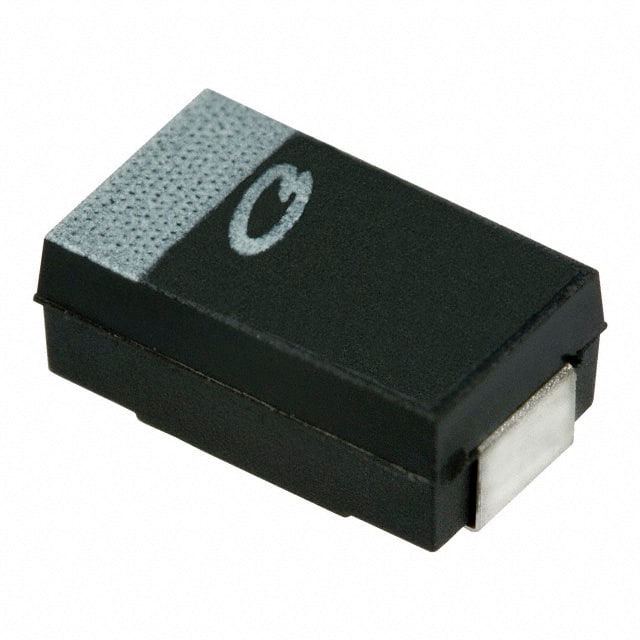
CAP TANT 22UF 25V 2917 Application Note: Design Guide for F931E226KNC
The KYOCERA AVX F931E226KNC is a 22 µF, 25 V, ±10% tantalum capacitor in the 2917 (EIA) case size, built on AVX's F93 series solid tantalum technology with a conductive polymer or manganese dioxide construction depending on lot specification—confirm this on the datasheet before finalizing derating strategy, because the two chemistries have different failure modes and voltage derating rules. In practice this part functions best as a bulk decoupling and energy-storage element in the intermediate frequency band, sitting between ceramic capacitors (which handle high-frequency transients) and larger electrolytics or inductors. Recommended topologies include point-of-load regulator input and output filtering, intermediate rail decoupling on multi-rail boards, and RC or LC snubber networks where a defined ESR provides damping. Avoid using this part as the sole output capacitor on a low-ESR switching regulator unless the control loop has been compensated for its ESR zero; tantalum ESR is useful for stability but must be modeled explicitly in the loop analysis.
For supporting passives, pair the tantalum with a low-ESR ceramic of 100 nF to 1 µF in parallel to cover high-frequency impedance, placed physically adjacent to the load or IC pin. When the tantalum is used in a filtering network, select the series resistor or inductor so that the resonant frequency of the LC pair falls well below the regulator's switching frequency and above the control loop bandwidth. For input filters, a 0.1 µF ceramic plus the 22 µF tantalum forms a reasonable two-stage decoupling network. If the tantalum is used in a timing or energy-storage role, verify the RC time constant against the worst-case capacitance tolerance of ±10% and the ESR variation over temperature. Choose resistors with adequate power rating and low temperature coefficient, and avoid using high-K ceramics in the same filter node where their DC bias derating would shift the effective capacitance significantly.
PCB layout for the 2917 package requires attention to pad geometry and thermal relief. Use the manufacturer-recommended land pattern, and keep trace inductance low by placing the capacitor as close as possible to the IC power pins, with the return path directly to the ground plane through vias placed at both terminals. Do not daisy-chain power through the capacitor pads; route power to the load and tap the capacitor with short stubs. For the ground connection, use multiple vias per pad rather than a single via, since the 2917 body can carry significant transient current. Keep the capacitor away from hot components—tantalum leakage current and reliability degrade with temperature—and provide copper pour under the body only if thermal management is needed, since excessive thermal coupling from adjacent power devices can shorten life. Avoid routing sensitive analog traces beneath the capacitor body where possible.
From an EMC standpoint, the tantalum's moderate ESR makes it a natural damping element for suppressing resonant peaks in power distribution networks, but it is not a high-frequency solution on its own. Use it in combination with ceramics to flatten the PDN impedance across frequency, and verify with a vector network analyzer or impedance analyzer that no resonance peak exceeds your target impedance. For conducted emissions, place the tantalum on the input side of switching converters with a small series ferrite or inductor to form a low-pass filter. For radiated emissions, the capacitor's location relative to board edges matters: keep current loops small and avoid placing the part where its loop area couples to cables or chassis. If the design is subject to automotive or industrial EMC standards, add a transient voltage suppressor or clamp diode in parallel where the tantalum sees inductive load switching, since tantalum capacitors are sensitive to voltage transients above rated voltage.
Common pitfalls include operating at or near the 25 V rating—tantalum capacitors should generally be derated to 50% of rated voltage for manganese dioxide types and 80% for polymer types, so a 25 V part is best used on rails of 12 V or lower for long-life applications. Another frequent error is reverse polarity or AC ripple with a negative component; even brief reverse bias can cause failure, so verify polarity marking and avoid circuits where the capacitor sees reverse voltage during startup or shutdown. Inrush current is a serious concern: a low-impedance source charging the capacitor can exceed the surge rating, so add a series resistor or use a soft-start scheme, particularly on hot-plug inputs. Also avoid mounting the part near board flex points, since 2917 tantalum bodies are susceptible to mechanical cracking that leads to leakage or shorts. Finally, do not substitute a generic tantalum for this part without checking ESR and surge ratings, as the F93 series has specific surge-tested variants.
For prototyping, build the first article with the exact land pattern and verify capacitance and ESR with an LCR meter at the intended operating frequency. Bench-test the circuit under worst-case conditions: maximum ambient temperature, maximum ripple current, and startup transients. Use a current probe to measure inrush and confirm it stays within the datasheet surge rating. Perform a thermal soak at the upper operating temperature for several hours and monitor leakage current, which rises with temperature and can indicate degradation. For EMC pre-compliance, run conducted emissions scans with and without the capacitor to confirm its contribution, and use a near-field probe to check for unexpected radiation from the power loop. If the design is production-bound, include a burn-in or accelerated life test on a sample lot and confirm the part's moisture sensitivity level before reflow.