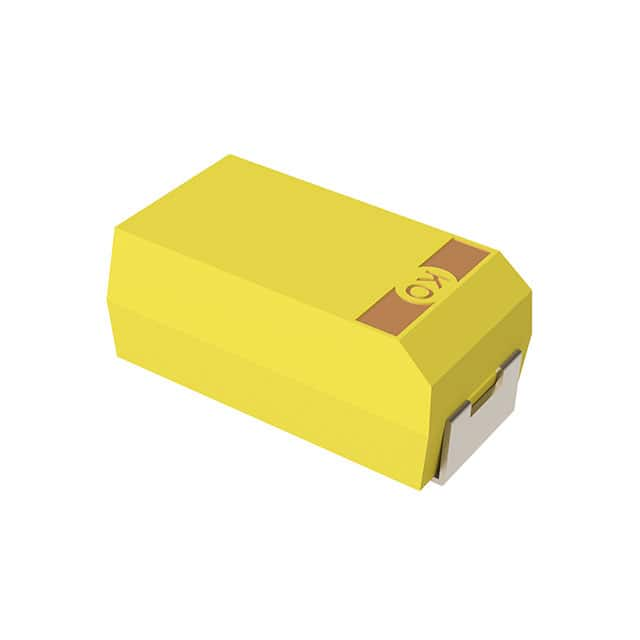
Troubleshooting Tips for CAP TANT POLY 100UF 25V 2917 Failures
When customers call me about a KEMET T543X107M025AHW0607505 (100 µF, 25 V, X-case 2917 polymer tantalum), the conversation usually starts with "the board works fine, then it doesn't." Polymer tantalum is a different animal from legacy MnO2 tantalum: no ignition failure mode, much lower ESR, but it has its own failure signatures. Here is how I actually debug these.
Typical failure modes and root causes. The most common is short-circuit after a voltage transient. Polymer tantalum is rugged, but repeated surges above 25 V, or reverse bias even briefly, can break down the dielectric. Second is capacitance loss and ESR rise, often from thermal cycling or from over-reflow. Watch the reflow profile: the T543 series is rated for 3 passes at 260 °C, but a hot plate or a rework station with no profile control can cook the part. Third is mechanical cracking from board flex, especially with 2917 on a thin PCB. Fourth is solder voiding under the terminations, which shows up as intermittent behavior. Finally, counterfeit or mislabeled parts — a 16 V part marked as 25 V will fail exactly like an overvoltage short.
Step-by-step debugging. First, confirm the failure symptom: short, high leakage, low capacitance, or intermittent. Second, power down, remove the part or lift one pad, and measure DCR and capacitance out of circuit. Third, check the DC bias history — is this rail 12 V, 24 V, or 28 V nominal with transients? Fourth, inspect the solder joints with a microscope for voids and cracks. Fifth, check board flex and mounting. Sixth, substitute a known-good new part from a traceable source and retest. If the new part survives, the original was damaged or wrong; if it fails identically, the circuit is the problem.
Schematic and layout mistakes. The classic is using the part at more than 50–80 % of rated voltage in a hot environment. Polymer tantalum derates with temperature and applied voltage; at 85 °C and 25 V, you are at the edge. Another is no series resistance in a hot-plug or inrush path — the low ESR that makes polymer attractive also means huge inrush current. Layout mistakes: placing the cap far from the load with long traces, which adds inductance and makes it useless for decoupling; putting it next to a heat source; and using too few vias under the pads. Also check polarity silk — reverse bias kills these fast.
Verifying authenticity and quality. Buy only from authorized distributors, and check the date code and lot markings against KEMET's format. Measure ESR with a proper LCR meter at 100 kHz — a genuine 100 µF 25 V X-case polymer should be in the tens of milliohms, not hundreds. Do a capacitance check at 120 Hz and 100 kHz; large discrepancies suggest a different chemistry. X-ray or cross-section a sample if you suspect relabeling. Visually inspect for uniform termination plating and clean laser marking.
Measurement techniques and equipment. Use a 4-wire LCR meter (e.g., Keysight E4980A or a good bench meter) for ESR and capacitance, with short, kelvin-connected leads. Use a DC bias fixture if you need to see capacitance at operating voltage. For leakage, use a source-measure unit or a picoammeter after a 5-minute soak at rated voltage. For transients, a scope with a current probe on the input rail tells you whether inrush is the culprit. A thermal camera helps find the hot cap.
Suspect the component vs. the circuit. Suspect the component if the failure is a hard short with no history of overvoltage, if multiple boards from one lot fail, or if the part is from a gray-market source. Suspect the circuit if the failure is intermittent, if it correlates with hot-plug events, if the rail exceeds 25 V, or if the part sits near a regulator or hot resistor. In my experience, about 70 % of "bad cap" calls are actually circuit or assembly issues.
Real-world cases. One customer had a 24 V rail with a 30 V hot-plug spike; the T543 shorted on power-up. Adding a TVS and a small series resistor fixed it. Another had intermittent resets: the cap was 8 mm from the load with a long trace, so it wasn't decoupling. Moving it to the load pins solved it. A third had capacitance loss after rework — the technician used a hot air station at 400 °C. A controlled profile fixed the yield. A fourth bought parts on a marketplace; ESR was 3× spec and the marking was wrong — counterfeit. The lesson: verify the part, verify the circuit, then verify the process.