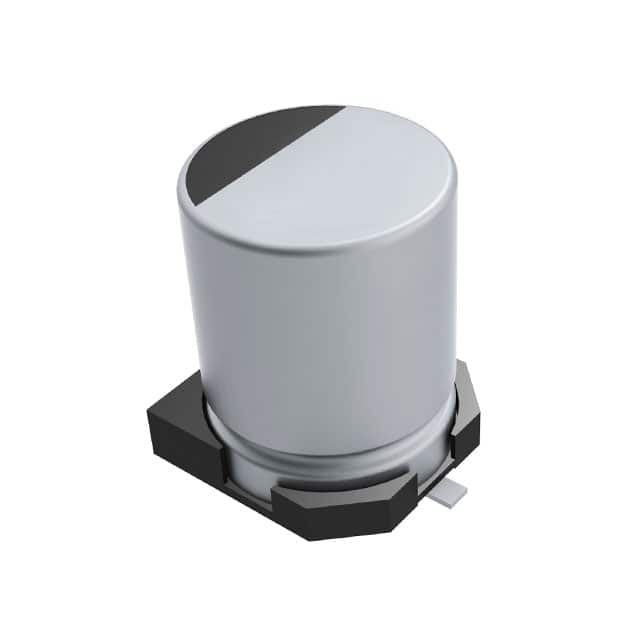
Troubleshooting Tips for CAP ALUM 220UF 25V SMD (EDT227M025S9PAA)
When customers call me about the KEMET EDT227M025S9PAA (220µF, 25V, 20%, SMD aluminum electrolytic), the conversation usually starts with "the board won't power up" or "it's making noise." This part is a workhorse in DC-DC converter input/output filtering and bulk decoupling, but like any aluminum electrolytic it has a finite life and specific sensitivities. Here is how I approach field failures on circuits using this capacitor.
Typical failure modes and root causes. The dominant failure is capacitance loss and ESR rise from electrolyte dry-out, accelerated by ambient temperature, ripple current heating, and proximity to hot components like inductors or linear regulators. A dried-out 220µF part can read 40µF or less with ESR climbing from tens of milliohms into the ohms range, which shows up as increased output ripple, instability in the converter loop, or brownout on load transients. Venting or bulging is usually a sign of reverse polarity, overvoltage beyond 25V, or excessive ripple current. The S9PAA case code is compact, so internal heating is real: derate ripple current per the datasheet and derate voltage to 80% or less for long life. Open-circuit failures are rare but happen after mechanical stress or cracked solder joints at the terminals. A short is almost always a downstream event—an overvoltage transient or a failed semiconductor dumping current into the cap—not the cap failing on its own.
Step-by-step debugging methodology. Start at the power rail: measure DC voltage and AC ripple with a scope, using a short ground lead and a 10x probe. Compare ripple against your design budget. Then measure ESR in-circuit with an ESR meter or LCR meter at 100kHz—a healthy part of this type should be well under 100mΩ, often in the 30–60mΩ range when new. If ESR is high, lift one terminal and re-measure to rule out parallel paths. Check capacitance with the same meter at 120Hz. Next, check the thermal environment: infrared camera or thermocouple on the cap body after 30 minutes at full load. If the can is running more than 10–15°C above ambient, you have a layout or ripple problem. Finally, verify the rail under transient load—step the load and watch for droop or oscillation, which points to insufficient bulk capacitance or excessive ESR.
Common schematic and layout mistakes. I see this part placed far from the load with long, thin traces, adding inductance and defeating its purpose. Loop area matters: the input capacitor loop to a buck converter should be tight. Putting the cap next to a hot diode or inductor shortens its life dramatically. Reverse polarity in a schematic symbol happens more than you would think—check the polarity marker against the silkscreen and the actual can stripe. Another classic: using a 25V part on a 24V rail with no margin; transients easily exceed 25V. Also, do not stack this cap in parallel without considering ESR balance, and do not assume it can absorb large inrush without a soft-start.
Verifying authenticity and quality. Counterfeit aluminum electrolytics exist, especially in distribution gray markets. Check the KEMET marking, date code, and case dimensions against the datasheet. Measure ESR and capacitance on a sample of incoming parts at 100kHz and 120Hz; counterfeit parts often read low capacitance or high ESR out of the bag. Look for consistent sleeve printing and terminal plating. Buy from authorized distributors and keep lot traceability—if a batch fails early, you want to correlate.
Measurement techniques and equipment. Use a good ESR meter or LCR meter for in-circuit checks, a scope with a proper probe for ripple and transient response, and a thermal camera for hot spots. For capacitance, a 120Hz measurement is standard for aluminum electrolytics; ESR is specified at 100kHz. Do not trust a basic DMM capacitance mode alone—it misses ESR, which is often the real culprit. For high-volume incoming inspection, a dedicated ESR tester speeds things up.
Component vs. surrounding circuit. Suspect the capacitor when ESR is high, capacitance is low, the can is bulged, or failures cluster in high-temperature locations. Suspect the circuit when the cap measures good but ripple is high—look at the inductor, feedback loop, or load transients. If a replacement cap fails again quickly, the root cause is almost certainly the circuit, not the part.
Real-world cases. One customer had a 12V rail oscillating at light load; the 220µF output cap read 35µF with 2Ω ESR after two years near a 3A linear regulator. Moving the cap away from the heat source and adding a 100µF low-ESR polymer in parallel solved it. Another had repeated cap venting on a 24V rail—the schematic showed a 25V part with no transient margin, and a hot-plug event was spiking to 30V. A 35V part plus a TVS fixed it. A third found a batch reading 50% low capacitance out of the reel; the parts were counterfeit, and switching to an authorized distributor ended the field returns. In every case, measurement data—ESR, capacitance, temperature—told the story before the schematic did.