IEC320-C14 Power Entry Modules: Industry Trends and Insights
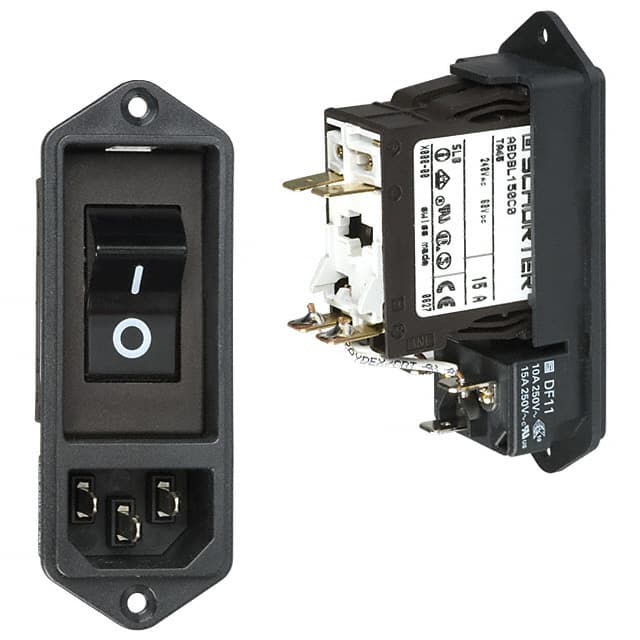
Power entry modules occupy a deceptively unglamorous position in electronic system design, yet they sit at the fault line between utility power and sensitive electronics. The SCHURTER DF11.1089.0010.01 — a panel-mount IEC 320-C14 receptacle with integrated line filter — exemplifies how far this category has evolved from simple connector hardware into a genuine electromagnetic compatibility (EMC) component. Understanding its trajectory offers procurement teams a useful lens on where the broader power entry segment is heading.
Technology and recent innovation. The core function of a filtered power entry module is to attenuate conducted emissions before they reach or leave the chassis. Modern designs integrate multi-stage LC filter networks, X and Y capacitors, and common-mode chokes into a compact panel-mount housing. Recent innovations in this class center on three fronts: higher attenuation density in smaller footprints, touch-safe terminal geometries that simplify assembly and reduce wiring errors, and improved thermal behavior under sustained load. SCHURTER's family of filtered entry modules also reflects a broader shift toward modularity — customers increasingly expect to specify filtering class, termination style, and fuse configuration without redesigning the panel cutout. That flexibility reduces qualification overhead for OEMs running multiple product variants off a common chassis.
Market trends and demand drivers. Demand for filtered IEC inlet modules tracks the installed base of equipment that must meet conducted emissions limits — industrial automation, medical devices, test and measurement, telecom infrastructure, and laboratory instrumentation. Three forces are pushing volumes upward. First, the proliferation of switching power supplies and variable-frequency drives raises ambient noise, making filtering less optional. Second, electrification of industrial equipment adds more power electronics per machine. Third, tightening EMC enforcement in major markets — including the EU's EMC Directive and equivalent regimes in North America and Asia — is prompting redesigns of legacy products that previously passed with marginal filtering. The medical segment deserves particular attention: IEC 60601 requirements for low leakage current constrain filter topology, and suppliers that can document leakage performance precisely are winning specification slots.
Supply chain dynamics. Filtered power entry modules are a mature, multi-source category, but not all sources are interchangeable. European manufacturers such as SCHURTER maintain production across multiple geographies, which cushions against single-region disruption. Lead times for standard configurations have largely normalized from the pandemic-era spikes, though custom filter classes and fuse configurations can still stretch to 12–16 weeks. Pricing is driven by copper and ferrite costs, capacitor film pricing, and labor — the latter pushing some commodity volume toward Asian manufacturers. Procurement teams should note that the filtered module segment has not seen the aggressive price erosion common in passive components; the value lies in EMC performance and certification documentation, not unit cost alone.
Emerging applications. Beyond traditional industrial and medical equipment, new demand is emerging from EV charging infrastructure (particularly AC wallboxes and test equipment), energy storage system enclosures, and edge computing installations in uncontrolled electrical environments. Laboratory and semiconductor fabrication equipment is another growth pocket, as process tools proliferate and each requires clean power entry. Data center power distribution, while often using different form factors, is also driving demand for higher-current filtered inlets.
Technology roadmap. The next generation of power entry modules will likely emphasize integrated digital monitoring — current sensing and filter health diagnostics — alongside continued miniaturization. Higher ambient temperature ratings and wider input voltage tolerance are on customer wish lists. Expect also to see more modules designed for automated assembly, with tape-and-reel packaging and reflow-compatible variants, as OEMs push panel assembly toward automation. Filter performance at higher frequencies (above 100 MHz) is becoming a differentiator as fast-switching GaN and SiC power stages generate noise at frequencies conventional filters handle poorly.
Regulatory impact. RoHS and REACH compliance is table stakes; the practical challenge is documentation continuity as substance restrictions evolve. Automotive qualification (AEC-Q200, IATF 16949) remains largely outside this product class, but adjacent markets — charging infrastructure, for example — are importing automotive-grade reliability expectations. Medical customers require ISO 13485 supply chains and precise leakage current data. Procurement teams should verify that certificates of conformity are current and that the supplier can trace material declarations at the lot level.
Strategic recommendations. First, treat filtered power entry modules as EMC-critical components, not commodity connectors — qualify at least two sources with documented filter performance, and avoid last-minute substitutions that could jeopardize certification. Second, lock in annual pricing agreements with buffer stock for custom configurations, given the 12–16 week tail on non-standard variants. Third, engage suppliers early on roadmap alignment, particularly if your designs are moving toward higher switching frequencies or automation-friendly assembly. Finally, build a documentation file for RoHS, REACH, and leakage current data per part number; regulatory audits increasingly demand it, and suppliers that provide it proactively are worth the modest premium.