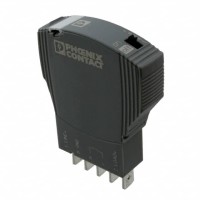
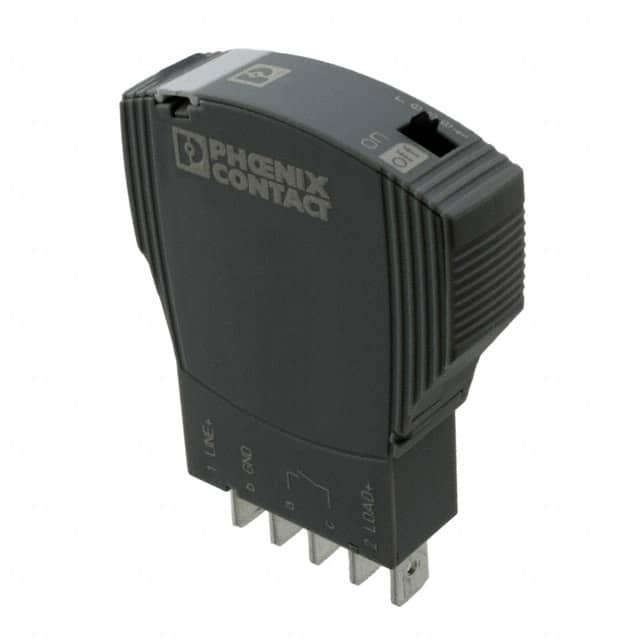
CIR BRKR SOLID STATE 2A 24VDC (2800902): Reliability Guide
Solid-state circuit breakers such as the Phoenix Contact 2800902 (2 A, 24 VDC) replace electromechanical trip mechanisms with semiconductor switching and electronic current sensing, which changes the reliability profile fundamentally. Buyers should expect qualification evidence aligned with IEC 60947-2 for circuit-breaker performance and IEC 60947-1 general rules, plus EMC conformity to IEC 61000-6-2/6-4 for industrial environments. Phoenix Contact typically supports UL 508 and UL 2367 recognition for 24 VDC solid-state devices; confirm the file number on the label. Because the device contains active semiconductors, AEC-Q100-style stress qualification is not applicable, but supplier PPAP-style documentation, ISO 9001/14001 certification, and MTBF data per Telcordia SR-332 or IEC 61709 should be requested. RoHS/REACH declarations and a material composition statement are baseline requirements.
Accelerated life testing for this class of device focuses on thermal cycling of the power stage, high-temperature operating life (HTOL) at elevated ambient, and repetitive short-circuit trip cycling. A credible supplier will present HTOL results at 85 °C or above with junction-temperature derating, plus endurance data for the rated 2 A continuous current and the trip threshold tolerance over temperature. When reviewing results, look for failure-mode distribution rather than pass/fail alone: parametric drift in trip time or on-resistance is an early-warning signal even if the unit still functions. Arrhenius extrapolation from HTOL should use the actual activation energy for the dominant failure mechanism, typically 0.7 eV for semiconductor wear-out; treat vendor extrapolations beyond two orders of magnitude of time with skepticism.
FIT rates should be calculated per IEC 61709 or Telcordia using part-stress analysis at the actual 24 VDC rail and enclosure ambient, not at nominal 25 °C. For a device of this complexity, a plausible order of magnitude is 10–50 FIT at 40 °C ambient, yielding an MTBF in the millions of hours; note that MTBF is a statistical reciprocal of failure rate, not a predicted service life, and says nothing about wear-out. Ask the supplier whether the figure includes connector and relay-free output-stage contributions. For safety-related use, request FMEDA data and diagnostic coverage rather than relying on MTBF alone.
Environmental stress screening should be applied to production lots only if the supplier's process capability is unproven; standard practice is 24–48 hour burn-in at 60–70 °C with full-load cycling, followed by functional and trip-time verification. Temperature cycling from −40 to +85 °C for 10–20 cycles is appropriate for lot qualification, not for every unit. Avoid over-stressing: excessive burn-in can consume useful life of electrolytic or interface components and mask rather than reveal defects.
Counterfeit risk for this SKU is moderate but real, given its use in automation panels. Verify the Phoenix Contact holographic or QR-coded label, check the article number 2800902 against the packaging and the device marking, and confirm date-code consistency between reel/box and unit. X-ray fluorescence can confirm lead-free plating and the absence of restricted substances; decapsulation or X-ray inspection of the internal PCB is warranted for high-value or safety-critical lots. Purchase only through franchised distribution and retain traceability to the manufacturer lot.
Incoming inspection should combine 100% visual and label verification with AQL sampling for trip-time accuracy at 2 A and 24 VDC, contact-resistance or voltage-drop measurement, and insulation resistance. Functional test at cold and hot extremes on a sample basis catches thermal drift. Record all results against the lot number so trends are visible before field failures occur.
Store in original sealed packaging at −25 to +70 °C, below 75% RH, away from corrosive atmospheres; solid-state breakers are sensitive to ESD on their terminals, so handle with grounded wrist straps and keep protective caps in place until installation. Observe shelf-life guidance, typically 12–24 months, and re-verify function after long storage. At end of life, monitor Phoenix Contact PCN/EOL notices, secure a last-time buy sized to remaining production plus spares, and qualify an alternate with equivalent trip characteristics before the original is discontinued.