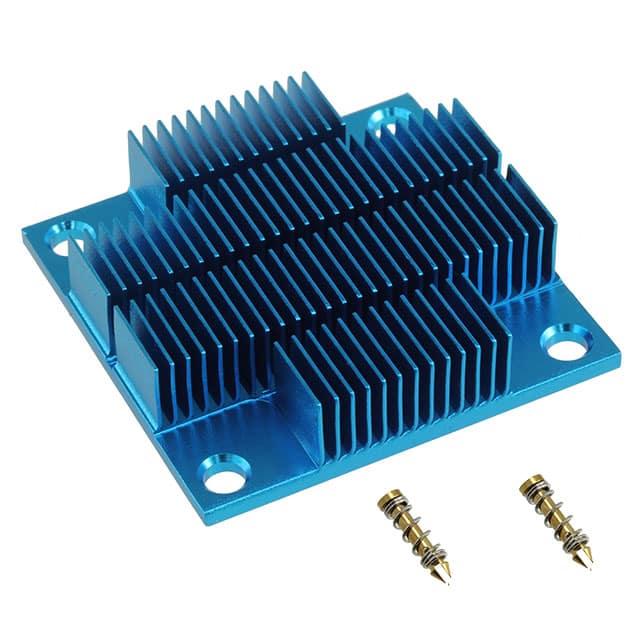
HEATSINK 25X25X10MM R-TAB T766: Industry Insight on Thermal Design Trends
The small-format heatsink has quietly become one of the more strategically interesting line items in the electronics BOM. The ATS-04B-165-C2-R0 from Advanced Thermal Solutions Inc.—a 25 x 25 x 10 mm extruded aluminum sink with a solderable R-tab—is a useful lens through which to examine where thermal management is heading. This class of component sits at the intersection of three forces: rising power density in compact packages, the push toward automated assembly, and tightening environmental compliance. Understanding its trajectory helps procurement teams anticipate both risk and opportunity.
The device itself is straightforward engineering executed well: an extruded aluminum profile with a dedicated tab for reflow soldering, allowing pick-and-place mounting and eliminating the manual screw or clip steps that dominate the cost of small heatsink attachment. Recent innovation in this segment is less about fin geometry than about attachment and interface. Suppliers are tightening tab coplanarity tolerances, qualifying pre-applied phase-change materials and thermal tapes, and offering tape-and-reel packaging. Advanced Thermal Solutions' broader portfolio also reflects a shift toward integrated thermal design services and simulation-backed selection tools, which matters because engineers increasingly choose standard parts through online configurators rather than custom drawings.
Demand drivers are favorable. The component segment is being pulled by edge AI, 5G small cells, power-over-Ethernet infrastructure, LED drivers, and dense DC-DC converters, all of which pack more dissipation into shrinking envelopes. Board-level thermal management is also spreading into industrial automation, test and measurement, and medical devices where forced air is unavailable and passive or conduction cooling is the only option. The 25 mm footprint is particularly attractive in point-of-load converters and optical modules, where every millimeter of board space is contested.
Supply chain dynamics are comparatively benign but not risk-free. Extruded aluminum is sourced globally, with die costs concentrated in Asia and finished machining and assembly often regionalized to shorten response times. Standard catalog heatsinks typically carry lead times of a few weeks, though custom tooling or non-standard finishes can extend that significantly. Pricing tracks aluminum ingot and energy costs, which have been volatile; expect modest upward pressure on commodity grades and premiums for solderable finishes and qualified thermal interfaces. Distributor stocking programs and multi-source qualification of equivalent profiles are the practical hedges.
Emerging applications are broadening the base. Electric vehicle charging electronics, battery management systems, and onboard chargers use small extruded sinks in volume. Data center optics and coherent transceivers are another growth pocket, as are robotics controllers and drone power electronics. Each of these brings automotive or industrial qualification expectations that raise the bar on documentation, traceability, and reliability testing.
Regulatory impact is real and growing. RoHS and REACH compliance is table stakes, but the focus is shifting to finishes and interface materials—hexavalent chromium-free conversion coatings, low-VOC thermal adhesives, and conflict-mineral disclosure. For automotive-adjacent programs, AEC-Q104-style board-level qualification and PPAP-style documentation are increasingly requested even for passive thermal parts. Suppliers that maintain current material declarations and test reports will win share; those that treat compliance as paperwork will lose it.
The technology roadmap points toward higher-performance interfaces, integrated thermal-electrical functions, and additive manufacturing. Expect more pre-applied phase-change materials tuned for reflow, vapor-chamber and heat-pipe variants in small footprints, and 3D-printed geometries for low-volume or complex profiles. Digital twins and thermal simulation libraries will make selection faster, and sustainability credentials—recycled aluminum content, lower-carbon extrusion—will become differentiators in tenders.
For procurement teams, the strategic recommendations are clear. Qualify at least two sources for each critical profile and maintain approved alternates for interface materials. Lock in annual pricing with aluminum index clauses rather than accepting spot exposure. Require current RoHS/REACH declarations and reliability data as part of the supplier scorecard. Engage early with design engineering to standardize on catalog parts that carry distributor stock, reducing expedite costs. Finally, monitor the shift toward pre-applied interfaces and reel packaging—these reduce total landed cost even when unit price is higher, and they align with the automation investments most assembly lines are making now.
HEATSINK 25X25X10MM R-TAB T766
Advanced Thermal Solutions Inc. | ATS-04B-165-C2-R0 | $5.24