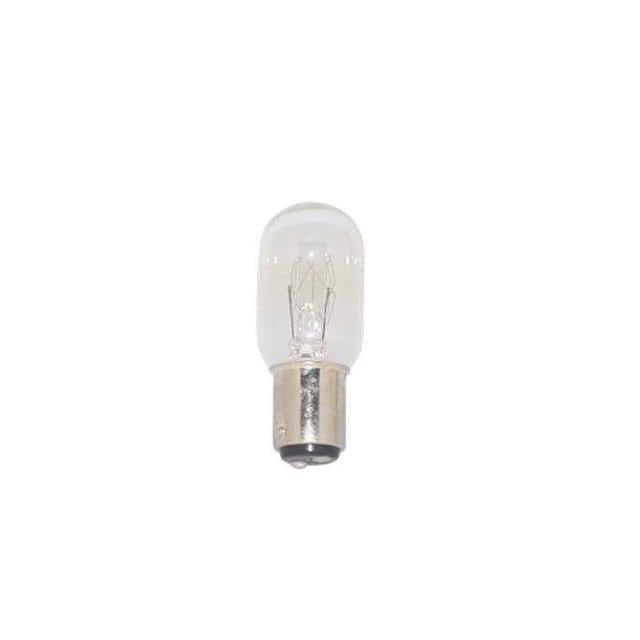
15W 120/130V DCB Base (BA15D) Comparison Guide: WX-JA2E-8
When buyers encounter the Interlight 15W 120/130V DCB BASE (BA15D), SKU 2PAK:WX-JA2E-8, they are looking at a member of the miniature and specialty incandescent lamp family, specifically a double-contact bayonet-base bulb rated for 120 to 130 volts AC/DC operation. These lamps occupy a narrow but stubbornly persistent niche in electronic and electrical systems: indicator and panel lighting, appliance and equipment illumination, legacy instrument displays, and retrofit replacements in older machinery where the socket geometry and voltage rail are already fixed. The BA15D base—15 mm diameter, double contact, bayonet locking—is the defining mechanical interface here, and it is what distinguishes this part from the single-contact BA15S variant. In systems terms, the lamp is a simple resistive load that provides visible status or illumination; it is not a logic component, but its failure or absence can affect operator safety and maintenance diagnostics.
Several parameters drive selection in this category. Voltage rating is paramount: a 120/130V lamp is designed for direct connection to North American mains-derived rails, so applying it to a 24V control circuit will yield nothing, while a 24V lamp on a 120V rail will fail instantly. Wattage and luminous output determine brightness and heat load; 15W is a moderate draw for this form factor, and buyers should confirm that the fixture's thermal design tolerates it. Base type and contact configuration must match the socket exactly—BA15D for double-contact, BA15S for single—since forcing the wrong base damages sockets and creates shock hazards. Filament construction and rated life affect replacement frequency, and lens or finish (clear, frosted, colored) affects application suitability. Finally, buyers should check dimensional tolerances, because legacy sockets vary and a slightly long or short bulb may not seat reliably.
Compared with alternatives, this lamp sits in a mature, cost-sensitive segment. LED retrofit lamps in BA15D form factor offer dramatically longer life, lower energy use, and better vibration resistance, but they carry higher unit costs, can exhibit flicker or dimming incompatibility on some circuits, and may not match the exact light distribution or color temperature of an incandescent original. Halogen versions of similar bayonet lamps offer higher output for the same envelope but run hotter and shorter-lived. From a pure cost standpoint, the Interlight incandescent is inexpensive per unit and widely stocked through aftermarket channels, though brand-name OEM lamps may command premiums for documented life ratings. Availability is generally good for common voltages, but the specialty nature of the category means distribution is concentrated among a smaller set of suppliers than, say, standard LED modules. Performance-wise, the incandescent delivers predictable, dimmable, line-frequency-friendly behavior with no driver electronics to fail—an underrated advantage in harsh electrical environments.
Industry trends are pushing this category in two directions. On one side, efficiency regulations and corporate sustainability mandates are accelerating the shift toward LED replacements, and many OEMs now specify LED-only for new designs, which shrinks the addressable market for incandescent specialty lamps over time. On the other side, the installed base of legacy equipment—industrial controls, older medical and test instruments, vintage audio and aviation panels—remains large and slow to retrofit, sustaining steady replacement demand. Buyers should also note supply-chain consolidation: as major lamp manufacturers exit or trim incandescent lines, aftermarket brands like Interlight increasingly fill the gap, which affects documentation quality and lot-to-lot consistency. Counterfeit and mislabeled lamps are a real risk in this space, so sourcing from distributors with traceable SKUs matters.
Choose this specific component when the application calls for a direct drop-in replacement in an existing BA15D socket at 120/130V, when dimming or simple resistive behavior is required, when the fixture cannot accommodate LED driver electronics or heat-sinking, or when cost per unit and immediate availability outweigh long-term energy savings. It is also the pragmatic choice for low-duty-cycle indicator service where lamp life is not the binding constraint. Conversely, for high-vibration environments, high-duty-cycle illumination, or applications where energy and maintenance costs dominate the total cost of ownership, an LED BA15D retrofit is usually the better engineering decision despite the higher upfront price.
On procurement, buyers should treat this as a mature, lifecycle-stable but slowly declining part. Lead times are typically short for in-stock aftermarket inventory, but spot shortages occur when a manufacturer discontinues a voltage or finish variant, so maintaining buffer stock for critical spares is prudent. Confirm the supplier's lifecycle status and ask whether the exact SKU is active or a last-time buy. Second-source options exist among other aftermarket lamp brands and OEM cross-references, but base configuration, voltage, and wattage must be verified part-by-part rather than assumed. For critical equipment, qualify an alternate brand and an LED retrofit in parallel, document the approved substitutes, and review the bill of materials annually as the incandescent supply base continues to narrow.