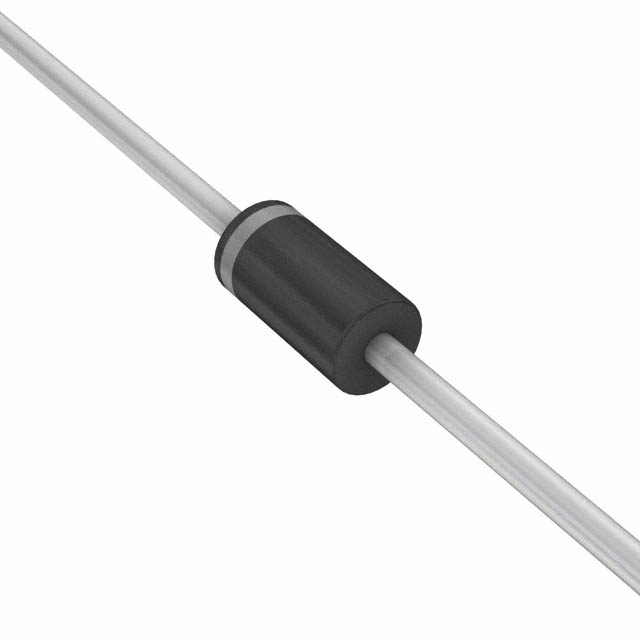
1N4001 Diode: Industry Insight on a 50V 1A Workhorse
The humble 1N4001-E3/73, a general-purpose rectifier diode from Vishay General Semiconductor, may seem like a commodity component, but its enduring relevance provides a powerful lens through which to view the entire discrete diode market. This specific SKU, rated for 50V and 1A in the ubiquitous DO-204AL (DO-41) package, is a workhorse of power conversion, and its current status reveals much about technology, supply, and strategy.
The Technology and Recent Innovations
The foundational technology of the 1N4001 series is a silicon PN junction designed for 50/60Hz mains frequency rectification. While the basic physics are decades old, the innovation lies in the manufacturing. Vishay’s "E3" suffix denotes a lead (Pb)-free, RoHS-compliant termination finish, a critical update. Recent innovations are not in the junction itself, but in process control and wafer fabrication. Improvements in passivation and glass sealing of the DO-41 package have enhanced reliability, particularly in high-humidity environments. Furthermore, advancements in epitaxial deposition allow for tighter parameter control, reducing forward voltage drop (Vf) variability and improving efficiency in low-cost, high-volume applications. The "73" suffix indicates a tape-and-reel packaging, optimized for automated pick-and-place, a subtle but vital innovation for modern manufacturing lines.
Market Trends and Demand Drivers
The market for general-purpose rectifiers like the 1N4001 is mature but far from stagnant. The primary demand driver remains the global appetite for power supplies. Every wall adapter, LED driver, and battery charger for consumer electronics, small appliances, and industrial controls relies on such diodes for basic AC-to-DC conversion. The surge in IoT devices, smart home sensors, and low-power peripherals has created a steady, high-volume demand. Additionally, the push for energy efficiency regulations (like Energy Star and DoE Level VI) forces designers to minimize losses, but for low-power applications, the 1N4001’s 1A rating and 50V blocking voltage remain cost-optimal. The market is also seeing a shift toward higher temperature ratings in automotive and industrial environments, though the standard 1N4001 operates comfortably up to 150°C junction temperature.
Supply Chain Dynamics: Global Sourcing and Lead Times
The supply chain for Vishay’s 1N4001-E3/73 is a textbook case of a mature commodity market. Sourcing is global, with major manufacturing hubs in Asia (China, Malaysia, Philippines) and Europe. Lead times, which spiked to 20-30 weeks during the pandemic-era shortages, have now normalized to a stable 8-12 weeks for standard orders. However, this stability is fragile. The pricing outlook is currently flat to slightly declining, driven by overcapacity in the Chinese foundry market and increased competition from second-source manufacturers. Yet, procurement teams must be aware that Vishay’s brand carries a premium for guaranteed quality and traceability. The real risk is not a direct shortage of 1N4001s, but rather constraints in the supply of leadframes and epoxy molding compounds, which can disrupt delivery schedules. We recommend a dual-sourcing strategy—using Vishay as a primary, high-reliability source, with a qualified alternate for non-critical builds.
Emerging Applications Driving New Demand
While the 1N4001 is not a cutting-edge component, it is finding new life in surprising sectors. The rise of renewable energy micro-inverters and energy harvesting modules (e.g., for solar-powered garden lights or small wind turbines) uses these diodes for basic rectification of low-voltage AC. In the medical device space, portable monitors and diagnostic tools require cost-effective, reliable power supplies where the 1N4001’s proven track record is valued over exotic new parts. Another emerging application is in electric vehicle (EV) auxiliary systems—not the main traction inverter, but for low-voltage DC-DC converters, battery management system (BMS) isolation, and cabin electronics. The automotive qualification (AEC-Q101) is not standard for this SKU, but its industrial-grade reliability is sufficient for many non-safety-critical automotive functions.
Technology Roadmap: What’s Next for This Component Category
The future of the standard rectifier diode category is one of incremental, not radical, change. The primary trend is miniaturization and integration. We are seeing the rise of surface-mount (SMD) alternatives like the 1N4001S in the SMA package, which reduces board space. However, the through-hole DO-41 remains dominant for its superior thermal dissipation and ease of manual replacement. The technology roadmap points toward lower forward voltage drops (sub-0.9V at 1A) through Schottky or advanced epitaxial designs, but these come at a higher cost. For the 1N4001 segment, the improvement will be in enhanced surge current capability and reduced reverse recovery time (trr), making them suitable for higher-frequency switching power supplies without sacrificing cost. Expect to see "fast recovery" variants offered as drop-in replacements for the standard 1N4001.
Impact of Industry Regulations
Regulations are a constant force. The 1N4001-E3/73 is fully compliant with RoHS (Restriction of Hazardous Substances) and REACH (Registration, Evaluation, Authorisation and Restriction of Chemicals), which is non-negotiable for European and most global markets. The "E3" designation explicitly confirms this. For automotive applications, the base 1N4001 is not AEC-Q101 qualified, which is a critical distinction for procurement teams. Using this part in a safety-critical automotive system would violate qualification requirements. For industrial and consumer goods, however, the standard industrial-grade qualification is sufficient. Emerging regulations around PFAS (per- and polyfluoroalkyl substances) in packaging materials may also force changes in encapsulation resins, but Vishay is proactively addressing this. Procurement must always verify the latest datasheet for compliance certifications.
Strategic Recommendations for Procurement Teams
For a component as ubiquitous as the 1N4001-E3/73, the procurement strategy should focus on cost optimization and supply assurance, not innovation. First, leverage high-volume agreements for pricing, as this is a price-sensitive commodity. Second, maintain a safety stock of 4-6 weeks of forecasted demand, as lead times, while stable, can tighten unexpectedly due to raw material constraints. Third, qualify at least one alternative manufacturer (e.g., ON Semiconductor, Diodes Inc.) for a second-source strategy, but ensure the alternative meets the same Vishay-specified electrical and mechanical parameters. Fourth, monitor the transition to SMD packages; while DO-41 is not obsolete, SMD variants will become more cost-competitive in high-volume automated assembly. Finally, engage directly with Vishay’s field application engineers to understand any upcoming end-of-life notifications or packaging changes. In a market where the component is a "known quantity," the best procurement strategy is to treat it as a critical commodity, not a forgotten one.
DIODE GEN PURP 50V 1A DO204AL
Vishay General Semiconductor - Diodes Division | 1N4001-E3/73 | $0.25