CGHV35150F Reliability Guide: Maximize RF MOSFET HEMT Life
When evaluating the reliability and quality of the Wolfspeed CGHV35150F RF MOSFET HEMT, a 50V gallium nitride (GaN) high-electron-mobility transistor designed for high-power RF applications, procurement professionals must adhere to rigorous standards. This component is typically qualified under JEDEC standards, specifically JESD22 for environmental and mechanical tests, and JESD47 for stress-test-driven qualification. Wolfspeed, as a manufacturer, often aligns with AEC-Q101 for automotive-grade reliability, though for commercial or defense RF applications, additional MIL-PRF-19500 or MIL-STD-750 guidelines may be referenced. Key qualifications include high-temperature reverse bias (HTRB) and high-temperature gate bias (HTGB) tests, which assess the device's ability to withstand prolonged voltage stress at elevated junction temperatures, typically 200°C or higher for GaN-on-SiC substrates.
Accelerated life testing (ALT) for the CGHV35150F is critical for predicting operational longevity. Tests like HTRB and high-temperature operating life (HTOL) accelerate failure mechanisms such as gate degradation, drain current collapse, and trap-induced dispersion. For GaN HEMTs, the Arrhenius model is commonly applied, with activation energies typically between 0.7 eV and 1.0 eV for time-dependent dielectric breakdown (TDDB). The results of ALT are used to estimate the device's useful life under normal operating conditions. For example, a 1,000-hour HTRB test at 200°C and 50V drain bias can project a median lifetime exceeding 10 million hours at a junction temperature of 150°C, assuming a conservative activation energy. However, procurement teams must note that ALT results are statistical, and performance varies with RF drive conditions, thermal cycling, and application-specific derating.
Failure rate calculations for the CGHV35150F are expressed in FIT (failures in time) rates, representing the number of failures per 10^9 device-hours. Based on industry data for similar GaN-on-SiC HEMTs, FIT rates are often below 100 FIT at a 90% confidence level under nominal operation. The mean time between failures (MTBF) is the reciprocal of the FIT rate, so a 50 FIT rate translates to an MTBF of 20 million hours. However, these figures assume proper derating, adequate heatsinking, and adherence to absolute maximum ratings. It is essential to request manufacturer-provided FIT data from Wolfspeed, as RF power devices can exhibit higher failure rates under pulsed or high-VSWR conditions. For critical systems, a reliability prediction per MIL-HDBK-217F or Telcordia SR-332 should be performed, incorporating the device's junction temperature and application-specific stress factors.
Environmental stress screening (ESS) and burn-in procedures are vital for eliminating infant mortality failures. For the CGHV35150F, a recommended burn-in involves a 48-hour to 96-hour test at 85°C ambient temperature with a 50V drain bias and a fixed RF input at rated power (150W typical) while monitoring drain current and output power. Thermal cycling between -55°C and 125°C for 100 cycles, per JEDEC JESD22-A104, can expose die-attach and wire-bond weaknesses. Vibration and mechanical shock screening per MIL-STD-202 or MIL-STD-883 should be applied for defense or aerospace procurement. For high-reliability applications, a 100% temperature cycle and burn-in are recommended, with pass/fail criteria based on a 10% shift in key parameters like drain current or RF gain.
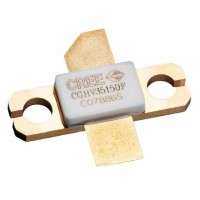
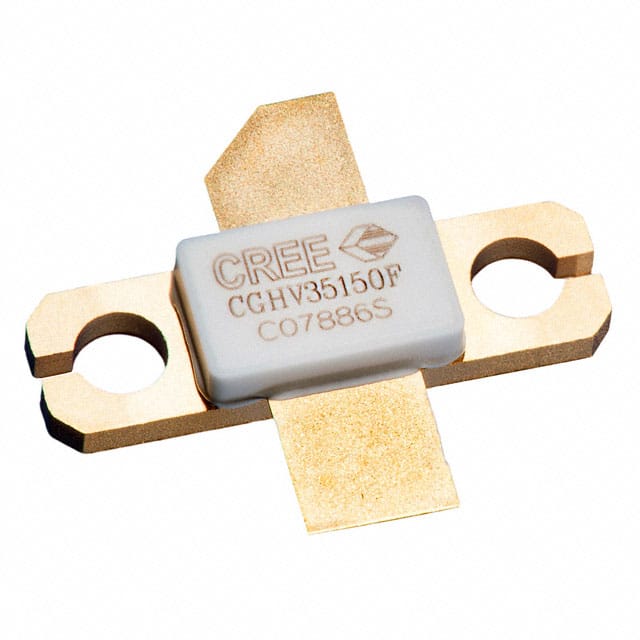
Counterfeit detection for this GaN HEMT demands specialized methods due to its unique semiconductor structure. Visual inspection under a high-magnification microscope (30x to 100x) should check for inconsistencies in the die marking, package mold flash, or lead finish. The CGHV35150F uses a ceramic or metal-ceramic package; counterfeit parts may exhibit poor laser marking, wrong part number fonts, or missing Wolfspeed logos. X-ray inspection can reveal internal die misalignment, incorrect bond wire counts, or foreign materials. Electrical testing is critical: a counterfeit device may show abnormal gate leakage current (Igss) or threshold voltage (Vth) outside the datasheet range of -3V to -1V. Thermal imaging during a brief power-up can detect mismatched thermal impedance, a red flag for fake dies. Always procure from authorized distributors and request traceable Certificate of Conformance (CoC) documentation.
Incoming inspection best practices for the CGHV35150F should include a thorough visual and dimensional inspection per IPC/JEDEC J-STD-020 for moisture sensitivity level (MSL). This component is typically MSL 3, requiring controlled storage and baking before reflow. Verify lead coplanarity and solderability, as poor terminations can cause RF performance issues. Electrical testing at incoming should include a DC parametric check (Idss, Vth, gate current) using a curve tracer or automated test setup, with limits set to ±20% of datasheet values. For RF performance, a sample-based test using a network analyzer at 3.5 GHz (typical frequency) can confirm gain and output power. Acceptable quality level (AQL) sampling per ANSI/ASQ Z1.4 with a 0.65% AQL for critical parameters is advisable, moving to 100% inspection for mission-critical lots.
Storage and handling are paramount for maintaining the CGHV35150F's reliability. The device is sensitive to electrostatic discharge (ESD) with a Human Body Model (HBM) rating of Class 1C (1,000V to 2,000V) per JEDEC JESD22-A114. Store in original moisture-barrier bags (MBB) with desiccant and a humidity indicator card at <5% relative humidity. If the MBB is opened, the floor life is 168 hours at ≤30°C/60%RH per IPC/JEDEC J-STD-033. For long-term storage, maintain a temperature of 15°C to 25°C in a dry nitrogen cabinet. Avoid repeated thermal shock from handling; use grounded ESD-safe tweezers and trays. Soldering must follow the recommended reflow profile, with peak temperature at 245°C for lead-free processes, and no more than three reflow cycles.
End-of-life (EOL) management and obsolescence planning for the CGHV35150F require proactive engagement with Wolfspeed. As a specialized RF component, it may have a limited production lifecycle. Procurement teams should request a product discontinuance notice (PDN) with a minimum 12-month last-time buy (LTB) window. For critical systems, consider a lifetime buy based on projected maintenance needs, storing parts in a controlled environment with periodic re-qualification (e.g., 5-year bake-out and electrical retest). Alternatively, plan for a second-source qualification with a similar GaN device, ensuring pin-compatibility and equivalent RF performance. Work with Wolfspeed's application engineers to identify potential drop-in replacements or design alternatives. For obsolescence mitigation, maintain a risk register that tracks component age, market demand, and manufacturer stability, updating it annually to avoid costly redesigns.